USAID DEC
Evolution of Pleistocene to Holocene eruptions in the Lesser Caucasus Mts:Insights from geology, petrology, geochemistry and geochronology
Sign inUSAID DEC
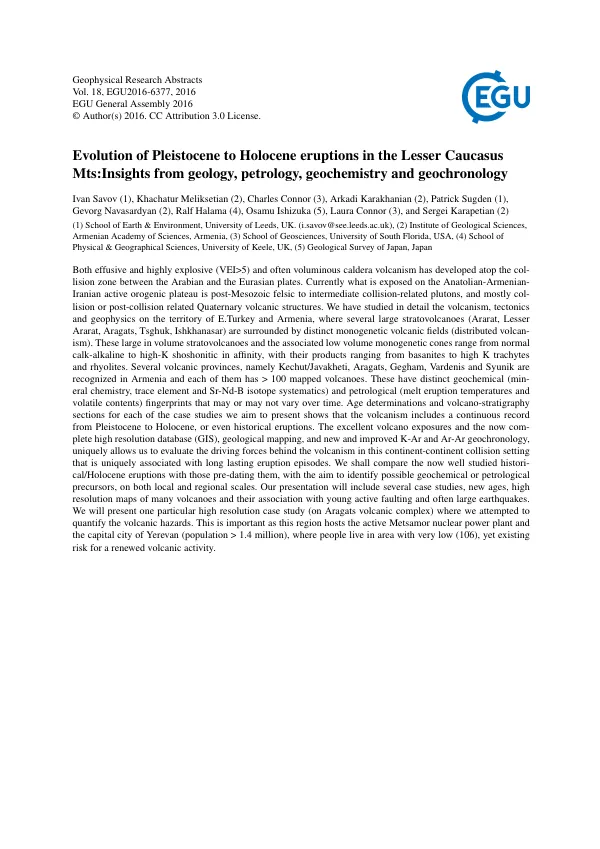
Evolution of Pleistocene to Holocene eruptions in the Lesser Caucasus Mts:Insights from geology, petrology, geochemistry and geochronology
The Lesser Caucasus Mountains have experienced a complex geological history, with both effusive and highly explosive volcanic activity developing atop the collision zone between the Arabian and Eurasian plates.
2016 · 1 pages
Sign in to readA free account is required to download.
Abstract
This region is characterized by post-Mesozoic felsic to intermediate collision-related plutons and Quaternary volcanic structures. The study area includes the territory of Eastern Turkey and Armenia, where several large stratovolcanoes are surrounded by distinct monogenetic volcanic fields. The stratovolcanoes and associated monogenetic cones in this region range from normal calc-alkaline to high-K shoshonitic in affinity, with products ranging from basanites to high-K trachytes and rhyolites. Several volcanic provinces have been recognized in Armenia, including Kechut/Javakheti, Aragats, Gegham, Vardenis, and Syunik, each with more than 100 mapped volcanoes. These volcanoes have distinct geochemical and petrological fingerprints, which may or may not vary over time. Age determinations and volcano-stratigraphy sections for each of the case studies presented in this research show that the volcanism includes a continuous record from the Pleistocene to the Holocene, or even historical eruptions. The excellent volcano exposures and high-resolution database, including geological mapping and new and improved K-Ar and Ar-Ar geochronology, allow for the evaluation of the driving forces behind the volcanism in this continent-continent collision setting. This setting is uniquely associated with long-lasting eruption episodes. The study aims to compare the well-studied historical/Holocene eruptions with those pre-dating them, with the goal of identifying possible geochemical or petrological precursors on both local and regional scales. One particular high-resolution case study, focusing on the Aragats volcanic complex, will be presented, where an attempt was made to quantify the volcanic hazards. This is significant, as the region hosts the active Metsamor nuclear power plant and the capital city of Yerevan, with a population of over 1.4 million, where people live in an area with a very low yet existing risk for renewed volcanic activity.