TETRA TECH ESI, INC.
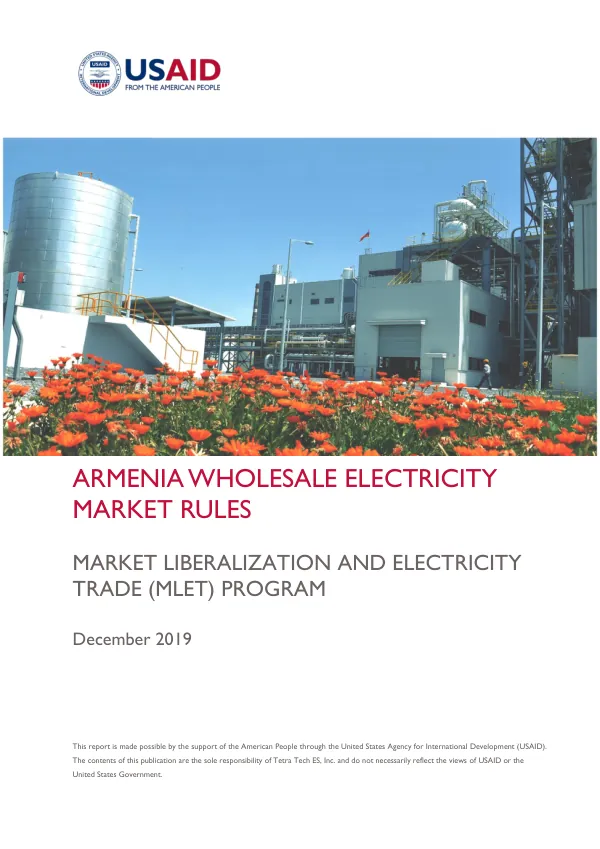
Armenia Wholesale Electricity Market Rules
The Armenia Wholesale Electricity Market Rules have been developed under the USAID Market Liberalization and Energy Trade (MLET) Program.
2019 · 61 pages
Sign in to readA free account is required to download.
Abstract
The program aims to support the Electricity Market reforms, the energy sector strategy development, as well as to promote cross-border trade with Georgia. This includes working towards facilitation of Armenian regulatory practices, as well as, harmonization with best international practices and with the EU directives. The Armenia Wholesale Electricity Market Rules are focused on clarification of the Armenia Electricity Market New Model and Electricity Trading Mechanism Concept defined by the RoA Public Services Regulatory Commission and bringing them in compliance with the RoA Energy Law requirements. The rules are intended to gradually introduce competition to the electricity market and increase security of supply through an enhanced regional electricity market integration. The Wholesale Electricity Market (WEM) shall define the structure, the principles of functioning of the WEM, the procedure for registration of WEM Participants, the Trading rules, Orders submission procedures, procedures for import and export of electricity, principles of functioning of the Bilateral Contracts, the Day-Ahead and Balancing Markets, procedures on provision of and payment for electricity and capacity supply and Ancillary services, requirements to the storage and transparency of WEM data, the rules and procedures aimed at increasing the efficiency of the WEM operation, as well as other rules required for well-organized, normal, and efficient operation of WEM. The main definitions used in these Rules include the Trading (Settlement) Period, which is a period of 60 minutes duration; Commercial Metering, which is the metering of electricity (capacity) quantities and provided services subject to payment within the framework of trading relations of WEM Participants; Commercial Meter, which is a metering device for commercial measurement of electricity (capacity) quantities stated in the WEM Contract; Trading day, which is a sequence of consecutive Trading periods starting from 00:00 until 24:00; Generator, which is an entity holding an electricity (capacity) generation license; Export Point, which is the crossing point of the interconnection line and the state border, where the export of electricity is carried out; and Distribution Network, which is a unified system of electricity distribution. The WEM Participants' responsibility, dispute (disagreement) resolution, and WEM Contract signing are also defined in the rules. The WEM Participants are responsible for submitting accurate and complete information, adhering to the Trading rules, and resolving disputes in a timely and efficient manner. The WEM Contract signing procedure is also outlined, including the requirements for registration, contract signing, and participant registration. The Market Management System Software is also an essential component of the WEM, and its modules are defined in the rules. The software is responsible for managing the WEM, including the Trading rules, Orders submission procedures, and procedures for import and export of electricity. The software also provides real-time data on the WEM, including the Trading (Settlement) Period, Commercial Metering, and Trading day. The Electricity System Annual Adequacy Forecast is another critical component of the WEM, and its methodology is outlined in the rules. The forecast is used to determine the adequacy of the electricity system, including the generation, transmission, and distribution of electricity. The forecast is also used to identify potential shortages and surpluses in the electricity system. The Electricity Trade in WEM is also defined in the rules, including the WEM segments, trade of electricity in the long-term contracts component of the bilateral contracts market, trade of electricity in the regulated component of the bilateral contracts market, and trade of electricity in the non-regulated component of the bilateral contracts market. The rules also outline the procedures for electricity trade, including the submission of Orders, the determination of the Trading price, and the settlement of trades. The Transit and Technical Power Flows are also essential components of the WEM, and their procedures are outlined in the rules. The rules define the procedures for cross-border trading, transit of electricity, and technical power flows, including the requirements for registration, contract signing, and participant registration. The WEM Payments Guarantees are also an essential component of the WEM, and their procedures are outlined in the rules. The rules define the procedures for making payments from the special account of the universal supplier and using the guaranteed amount (in terms of domestic consumption). The Metering and Invoicing of Electricity are also critical components of the WEM, and their procedures are outlined in the rules. The rules define the procedures for commercial metering, metering data collection and periodicity, metering of electricity at the generator's side, metering of electricity at the transmitter's and distributor's side, specific metering reconciliation, calculation of losses at the transmission network, and statement of charges. The Monitoring of WEM is also an essential component of the WEM, and its procedures are outlined in the rules. The rules define the procedures for data collection requirements, monitoring of DAM, and transitional provisions. The Armenia Wholesale Electricity Market Rules provide a comprehensive framework for the operation of the WEM, including the Trading rules, Orders submission procedures
Related documents