USAID
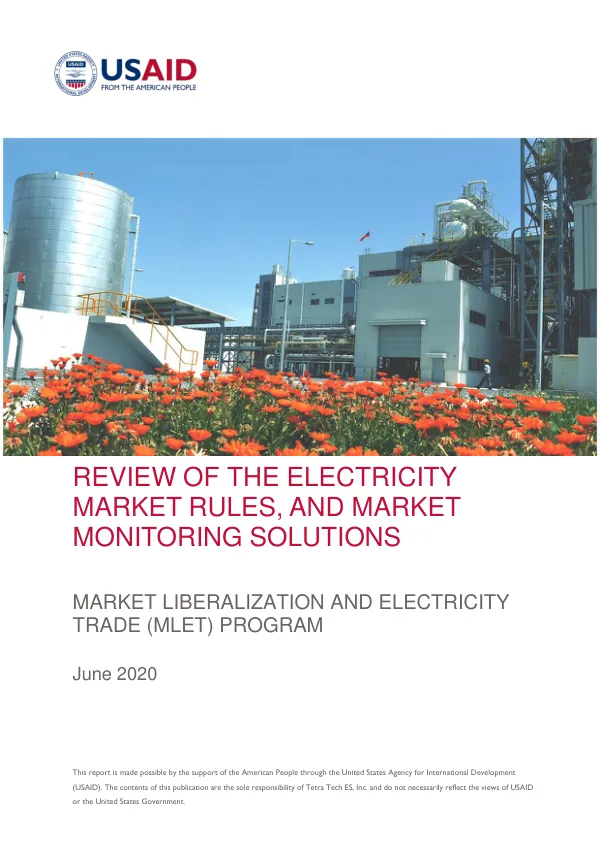
Market Monitoring in the Electricity Industry: International Experience
Market Liberalization and Electricity Trade in Armenia The Market Liberalization and Electricity Trade (MLET) Program, funded by the United States Agency for International Development (USAID, aims to support electricity market reforms, energy sector development, and cross-border trade with Georgia.
2020 · 35 pages
Sign in to readA free account is required to download.
Abstract
The program focuses on facilitating Armenian regulatory practices, aligning them with best international practices and EU directives. Market Monitoring Guidelines The MLET Program has developed Market Monitoring Guidelines, which consist of six sections: Economic Withholding, Market Outcomes, Physical Withholding, Transparency, Regulated Component of the Bilateral Contract, and Retail Monitoring. The guidelines provide an overview of the market monitoring process, including the rationale, tools, and tools used to analyze market outcomes. Economic Withholding Economic withholding occurs when a participant offers its resource at a price significantly higher than a competitive offer, aiming to raise market clearing prices. The analysis compares actual offers with reference values, which are estimates of marginal costs. The reference values are established using fuel and operating costs, excluding fixed costs. For renewables, a price-duration curve is commonly used. Detecting Economic Withholding To detect economic withholding, the dispatch of each hour is simulated using reference energy offer values. A Price-Cost Markup is calculated using the clearing price and the reference value of the marginal unit. The following table illustrates one day's evaluation, comparing the clearing price with the reference clearing price and calculating the Price-Cost Markup. DAM Hourly Clearing Report | Hour | Clearing Price | Reference Clearing Price | Price-Cost Markup | | --- | --- | --- | --- | | 1 | $45 | $45 | 0% | | 2 | $48 | $45 | 7% | | 3 | $50 | $45 | 11% | | 4 | $55 | $49 | 12% | | 5 | $65 | $49 | 32% | | 6 | $80 | $78 | 3% | | 8 | $70 | $78 | 10% | Units that set the price at the margin are analyzed to determine if they have exercised market power. If a resource at the margin offers above its reference value by a threshold (e.g., 10%), it may indicate an exercise of market power. Similarly, units that did not clear may exhibit evidence of exercising market power if their reference values are less than the competitive price and they offer above their reference value by a threshold (e.g., 10%). Participants identified as exercising market power should have an opportunity to explain their offer. Mitigation of market power may involve imposing an asset-specific offer cap based on their reference values or financial penalties. Market Monitoring The market monitoring process involves analyzing market outcomes, including economic withholding, physical withholding, and transparency. The analysis provides insights into market behavior, allowing for the identification of potential issues and the development of strategies to address them. The market monitoring guidelines provide a framework for analyzing market outcomes and detecting potential issues. Implementation of the Guidelines The implementation of the market monitoring guidelines is crucial for ensuring the effective functioning of the electricity market. The guidelines provide a framework for analyzing market outcomes and detecting potential issues, allowing for the development of strategies to address them. The implementation of the guidelines requires the collaboration of market participants, regulatory bodies, and other stakeholders. Regulatory Framework The regulatory framework plays a critical role in ensuring the effective functioning of the electricity market. The regulatory framework should provide a clear and transparent framework for market participants to operate within. The regulatory framework should also provide mechanisms for detecting and addressing potential issues, such as economic withholding and physical withholding. Cross-Border Trade The cross-border trade between Armenia and Georgia is an essential aspect of the electricity market. The cross-border trade allows for the exchange of electricity between the two countries, promoting economic efficiency and reducing the reliance on domestic generation. The cross-border trade also provides opportunities for market participants to access new markets and increase their revenue. Conclusion The Market Liberalization and Electricity Trade (MLET) Program aims to support electricity market reforms, energy sector development, and cross-border trade with Georgia. The program focuses on facilitating Armenian regulatory practices, aligning them with best international practices and EU directives. The market monitoring guidelines provide a framework for analyzing market outcomes and detecting potential issues, allowing for the development of strategies to address them. The implementation of the guidelines requires the collaboration of market participants, regulatory bodies, and other stakeholders.
Related documents