ROBERT NATHAN ASSOCIATES
Regional Agricultural Trade Environment (RATE) Assessment: Access to Finance
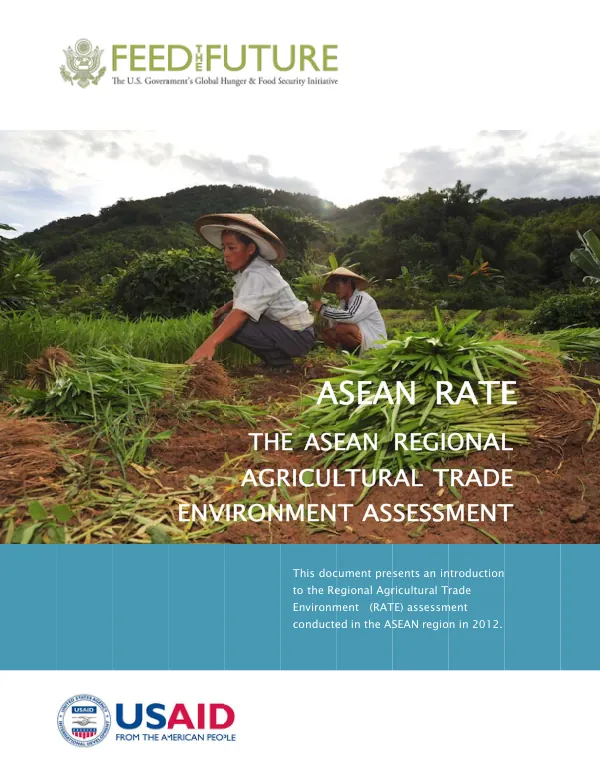
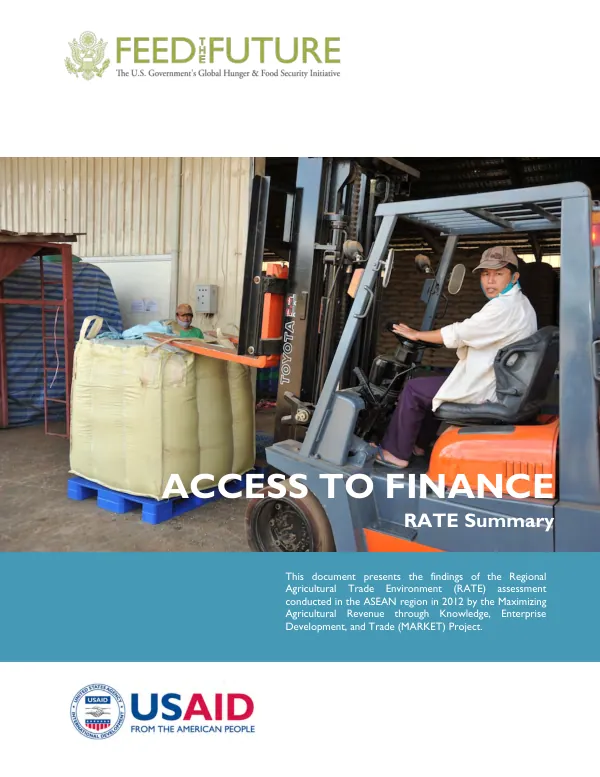
In the ASEAN region, the Regional Agricultural Trade Environment (RATE) assessment conducted in 2012 by the Maximizing Agricultural Revenue through Knowledge, Enterprise Development, and Trade (MARKET) Project highlighted the need for access to finance for micro, small, and medium-sized agricultural producers, processors, and traders.
2013 · 26 pages
Sign in to readA free account is required to download.
Abstract
The assessment found that small producers and agricultural enterprises often lack sufficient access to financial services, or available services come with unfavorable terms. Sources of finance in the agriculture sector vary from the formal to the informal, with the greatest needs for credit among SMEs. Lending to SMEs against moveable collateral, such as equipment, stored crops, and other inventory, and livestock, is increasingly accepted in theory but not in practice. Lending against intangible collateral, such as accounts receivable or intellectual property, is even rarer. Formal credit reporting is increasingly used to diminish risk in lending, but rural borrowers are widely overlooked by reporting systems. Agricultural enterprises, including farmers, microenterprises, and small and medium-sized enterprises (SMEs), seek finance from a range of financial institutions, from commercial banks for larger businesses to state-run agricultural development banks for medium or small enterprises, to microfinance institutions (MFIs) and informal lenders for small farms and microenterprises. Commercial banks tend to be risk-averse, so they often neglect smaller players in the agricultural sector in favor of less risky sectors. Collateral is an asset owned by a borrower that is pledged to a lender, who can legally hold or seize the asset in lieu of partial or total repayment of a loan should the borrower fail to comply with the terms of the loan. A well-structured secured transactions law expansively defines the property that can be used as collateral, and thus expands access to credit. In modern systems, collateral ranges from tangible property, such as tractors and processing equipment, to intangible property such as future crops or long-term contracts. The ASEAN Economic Community Blueprint includes a framework for promoting SME development, a key component of which is increasing access to credit to enhance SME competitiveness in ASEAN. The framework includes activities to establish an SME financial facility in each ASEAN Member State, conduct a feasibility study of SME credit systems, and set up a regional SME Development Fund. The ASEAN Insurance Training and Research Institute is a resource for insurance institutions focusing on developing insurance capacity in ASEAN's lower-income Member States. Opportunities for ASEAN and regional entities include developing regional guidelines on the legal and institutional framework for collateral lending, developing regional guidelines on the role of state-funded agricultural development banks, encouraging a regional discussion of agricultural insurance, and finalizing and implementing the proposed ASEAN SME Policy Index. Opportunities for Member States include streamlining secured transactions laws, creating or strengthening collateral registries to reduce lenders' risks, creating or improving the effectiveness of credit reporting systems, expanding access to microfinance services for SMEs, improving collection of statistics on access to finance in rural areas, and improving women's access to finance.