USAID DEC
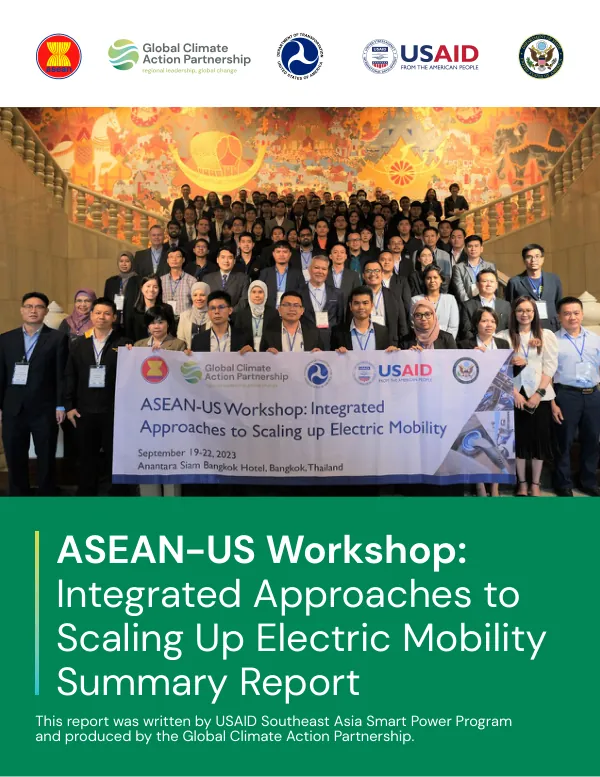
ASEAN-US Workshop: Integrated Approaches to Scaling Up Electric Mobility Summary Report
Sign inBANK FOR WEST AFRICAN DEVELOPMENT
ASEAN-US Workshop: Integrated Approaches to Scaling Up Electric Mobility Summary Report
The ASEAN-US Workshop: Integrated Approaches to Scaling Up Electric Mobility aimed to support government technical experts, regulators, policymakers, and private sector stakeholders in making data-informed policy decisions to facilitate a holistic and sustainable transition to electric vehicles (EVs) in the Association of Southeast Asian Nations (ASEAN) region.
2024 · 11 pages
Sign in to readA free account is required to download.
Abstract
The workshop was held from September 19-22 and convened 162 participants from ministries of energy, transport, and environment, as well as power sector regulators and utilities from eight ASEAN countries. The transportation sector represents one of the biggest emitters of greenhouse gas (GHG) emissions in ASEAN, and the transition to EVs has many benefits, including reducing GHG emissions and local air pollution, increasing energy security, and creating manufacturing and export opportunities. However, several barriers to EV adoption across the region were identified, including the lack of EV charging infrastructure, dependence on fossil fuels for electricity generation, lack of incentives and policies for private sector growth, and unclear regulatory and safety standards. The workshop featured leading experts from governments, global nongovernmental organizations, and leading private sector players from across ASEAN to speak on e-mobility in the region. Participants undertook activities to exchange knowledge on the opportunities and challenges of EV implementation, gain an up-to-date understanding of the status of EV policies, targets, and implementation efforts across ASEAN, and increase knowledge to gather and apply local data through best-in-class tools for decision-making. After 3.5 days of collaboration and exchange, participants expressed interest in an ASEAN-wide e-mobility road map and identified key components of such a road map, including defining emissions reduction targets, addressing air pollution, enabling better EV and EV battery supply chains, building a regional workforce for the EV ecosystem, and developing physical and regulatory infrastructure to harmonize EV adoption. For next steps, participants identified several priorities, including regional collaboration on EV supply chain, especially battery manufacturing, recycling, reuse, and other end-of-life management approaches; continued dialogue at the regional level between government bodies and the private sector on topics including vehicle manufacture, interoperable and universal EV charging station development, and clean grid expansion; and conducting life cycle and sustainability assessments for EVs to understand waste, water, and GHG emission impact. Country reports highlighted significant developments in EV policies and programs across ASEAN member states, including reduced import duties for EVs in Cambodia, policy to accelerate use of EVs through an entire EV ecosystem in Indonesia, and setting EV goal of 30% by 2025 in Lao PDR.