USAID DEC
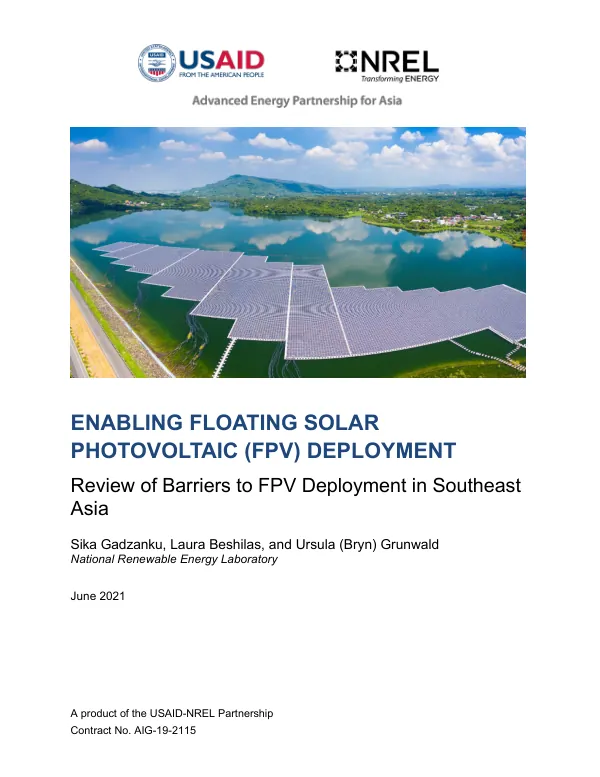
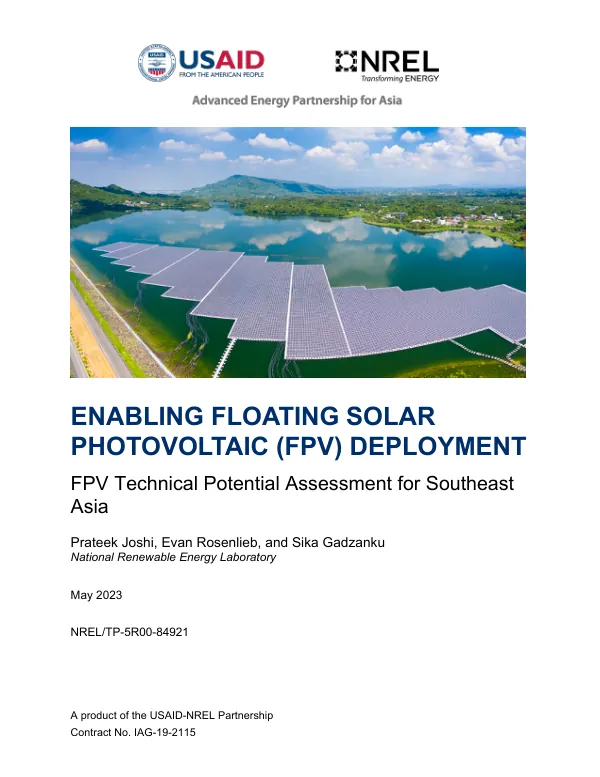
Enabling Floating Solar Photovoltaic (FPV) Deployment: FPV Technical Potential Assessment for Southeast Asia
Sign inU.S. NATIONAL RENEWABLE ENERGY LABORATORY
Enabling Floating Solar Photovoltaic (FPV) Deployment: FPV Technical Potential Assessment for Southeast Asia
Southeast Asia is a region with growing energy demand and increasing development of floating solar photovoltaic (FPV) systems.
2023 · 50 pages
Sign in to readA free account is required to download.
Abstract
FPV can help meet countries' renewable energy (RE) and energy security goals. The Association of Southeast Asian Nations (ASEAN) has set a regional target of 35% RE in installed power capacity by 2025. FPV is an increasingly popular option to help meet this objective, as it can avoid some of the challenges faced by ground-mount PV such as competing land use, and can take advantage of the significant existing and planned hydropower capacity in the region via co-location and hybridization. A high-level geospatial assessment methodology was used to estimate the technical potential for monofacial and bifacial FPV on reservoirs and natural waterbodies in the 10 countries within ASEAN. Technical potential consists of the suitable waterbody area for FPV development (km2), the capacity of FPV that could be installed on this suitable area (MW), and the annual energy that could be generated from these installations (GWh/year). The study included 7,301 waterbodies, with 88 reservoirs and 7,213 natural waterbodies. For the region, FPV technical potential ranges from 134-278 GW on reservoirs and 343-768 GW on natural waterbodies. The study found that FPV can play an important role in the region's renewable energy buildout. Under current policies, the installed capacity of renewables in ASEAN countries is expected to reach 235 GW by 2030, with 81 GW of utility-scale solar, and 1,311 GW by 2050, with 841 GW of utility-scale solar. Country-specific results for FPV technical potential are discussed in the report and differ in level of detail based on available data. For instance, transmission line data was only available for Cambodia, Laos, Myanmar, the Philippines, Thailand, and Vietnam. The methodology for calculating FPV technical potential might also be applicable for countries in other regions, with adaptations. However, due to data limitations, these results can be viewed as a conservative, upper-bound estimate of FPV technical potential in the region. Site-specific data on wind and waves, bathymetry, seasonal variation in water levels, and sedimentation were not available on a scale that would allow for consistent and reproduceable country- and region-wide geospatial analysis. The primary intended audiences for this work include decision makers within energy ministries and utilities considering the potential for FPV to support broader energy and development goals, energy system modelers tasked with exploring and quantifying the potential value that FPV installations may provide within a specific energy system, and developers that might be interested in building FPV in the SE Asia region. The study used a high-level geospatial assessment methodology to estimate the technical potential for monofacial and bifacial FPV on reservoirs and natural waterbodies in the 10 countries within ASEAN. The study included 7,301 waterbodies, with 88 reservoirs and 7,213 natural waterbodies. For the region, FPV technical potential ranges from 134-278 GW on reservoirs and 343-768 GW on natural waterbodies. The study found that FPV can play an important role in the region's renewable energy buildout, and the primary intended audiences for this work include decision makers, energy system modelers, and developers.
Related documents