USAID DEC
Assessing Needs: Tips & Facts Sheet
A needs assessment is a critical component of agricultural development initiatives, aiming to identify problems and opportunities by combining field observations with discussions.
2013 · 4 pages
Sign in to readA free account is required to download.
Abstract
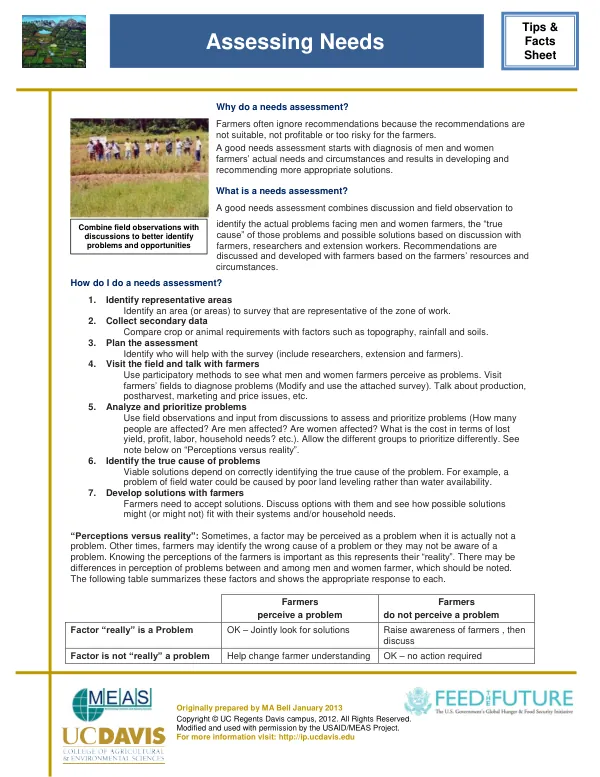
This approach enables the development of more appropriate solutions that cater to the actual needs and circumstances of men and women farmers. A good needs assessment starts with a diagnosis of farmers' actual needs and circumstances, resulting in the development and recommendation of more suitable solutions. This process involves identifying representative areas to survey, collecting secondary data, and planning the assessment. Researchers, extension workers, and farmers collaborate to gather information through participatory methods, including field visits and discussions. During the assessment, farmers' perceptions of problems are validated through field observations, and problems are prioritized based on factors such as the number of people affected, the cost in terms of lost yield or profit, and household needs. The true cause of problems is also identified, which is essential for developing viable solutions. For instance, a problem of field water may be caused by poor land leveling rather than water availability. Farmers need to accept solutions, and discussions with them help identify options that fit their systems and household needs. It is essential to note that farmers' perceptions of problems may differ from reality, and understanding these differences is crucial for effective needs assessment. The table provided summarizes the factors and responses to each, highlighting the importance of jointly looking for solutions when farmers perceive a problem, raising awareness and discussing the issue when farmers do not perceive a problem, and helping change farmer understanding when the factor is not a problem. The needs assessment survey sheet is a tool used to gather information from farmers, covering various production and post-production factors. The sheet is adaptable for different crops or commodities and includes sections on production factors, such as cropping systems, land preparation, and crop establishment, as well as post-production factors, such as harvest, processing, and marketing. The survey also collects information on farmers' perceptions of the greatest problems they face, which is essential for prioritizing needs and developing targeted solutions. By combining field observations with discussions, a needs assessment provides a comprehensive understanding of farmers' needs and circumstances, enabling the development of more effective solutions that cater to their actual requirements. This approach is critical for improving agricultural productivity, increasing household income, and enhancing food security.
Related documents