USAID DEC
Assessing the Scalability of an Early Childhood Development-Integrated Intervention in Eswatini
Sign inMEASURE EVALUATION PRH
Assessing the Scalability of an Early Childhood Development-Integrated Intervention in Eswatini
The ECD-integrated intervention in Eswatini, implemented by mothers2mothers (m2m), aims to improve the cognitive, social-emotional, language, and motor development and physical growth of vulnerable children ages 0–2 years and their parents and caregivers.
2019 · 5 pages
Sign in to readA free account is required to download.
Abstract
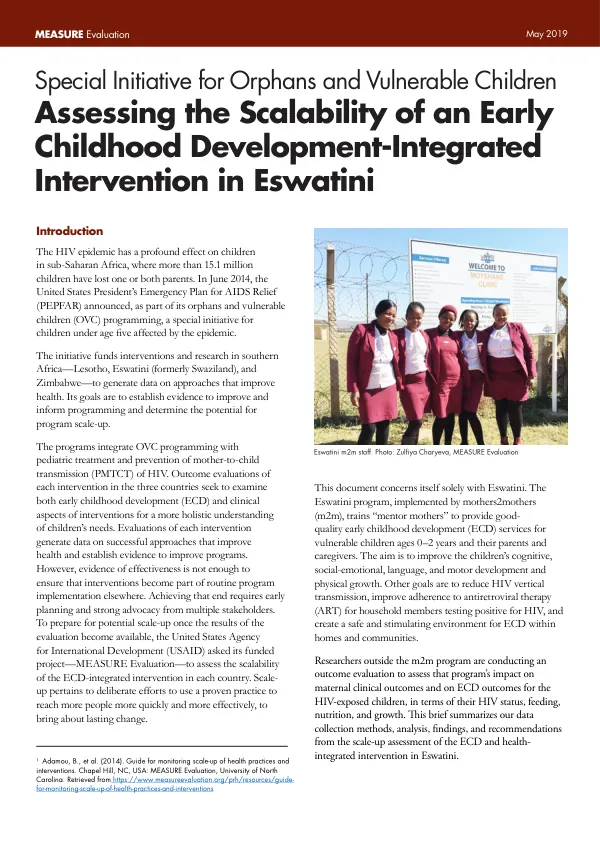
The program trains "mentor mothers" to provide good-quality early childhood development (ECD) services, which includes in-home support, peer support, and direct work with children through home visits, links to m2m's facility- and community-based PMTCT program, and parent information and play sessions (PIPS) for caregivers and children. Mentor mothers are central to m2m's programming, and their benefits include regular interaction, trust-building, and peer-to-peer rapport, as well as intense training and professionalism evident in their early childhood expertise, uniforms, and appropriate behavior. The m2m approach prioritizes recruiting mentor mothers from the communities to build rapport with clients and addresses the practical challenges of transportation for home visits and group learning. Mentor mothers are paid employees, not volunteers, which adds to their professionalism and accountability. Stakeholders at all levels had positive opinions about the program, mentioning the positive effects of integrating ECD in PMTCT, high coverage of pregnant women in intervention areas, and provision of one-to-one support in the home. In-home support reduces time, travel, and cost for caregivers, allows the intervention to be tailored to a client's needs, and builds a relationship grounded in mutual trust. PIPS allowed mothers to learn from one another, and other strengths were comprehensive training, locally adapted materials, buy-in at multiple levels, and the organization, supervision, and monitoring of the program. However, challenges arose in recruiting qualified mentor-mother candidates in rural areas, including ECD being a new subject for mentor mothers and caregivers, requiring extensive training and follow-up supervision. Mentor mothers were attractive candidates for other jobs, leading to staff turnover. The scale-up assessment consisted of a desk review, qualitative data collection, and cost estimation. Qualitative data were collected through 37 key informant interviews with program implementers, government and civil society stakeholders, and donors using a semistructured set of data collection tools. The cost estimation phase included a costing questionnaire and a cost estimation tool, completed by m2m program staff and supplemented through in-person meetings and conference calls. The assessment identified broad themes and factors affecting scale-up, including the lack of coordination and oversight among stakeholders, the need for additional advocacy to help others understand the importance of ECD, particularly the 0–2 age group, and the potential for economies of scale and resource substitution in the scale-up scenarios. The results of the assessment highlight the potential for the ECD-integrated intervention to be scaled up in Eswatini, but also emphasize the need for continued advocacy and support to overcome the challenges and limitations identified. The stakeholder context in Eswatini is complex, with multiple departments and agencies involved in children's welfare, but lacking coordination and oversight. The Ministry of Health focuses on children ages 0–2 for immunization, nutrition, and growth, while the Ministry of Education focuses on education and development, primarily beginning at preschool age. Other departments focus on protection from violence, poverty, or welfare, but there is no single agency or department responsible for the comprehensive well-being of children ages 0–2. Despite the challenges, most stakeholders advocated for scale-up, and additional advocacy may be needed to help others understand the problem and the potential solution piloted by m2m. The assessment highlights the need for continued support and advocacy to overcome the challenges and limitations identified and to ensure the successful scale-up of the ECD-integrated intervention in Eswatini.