USAID DEC
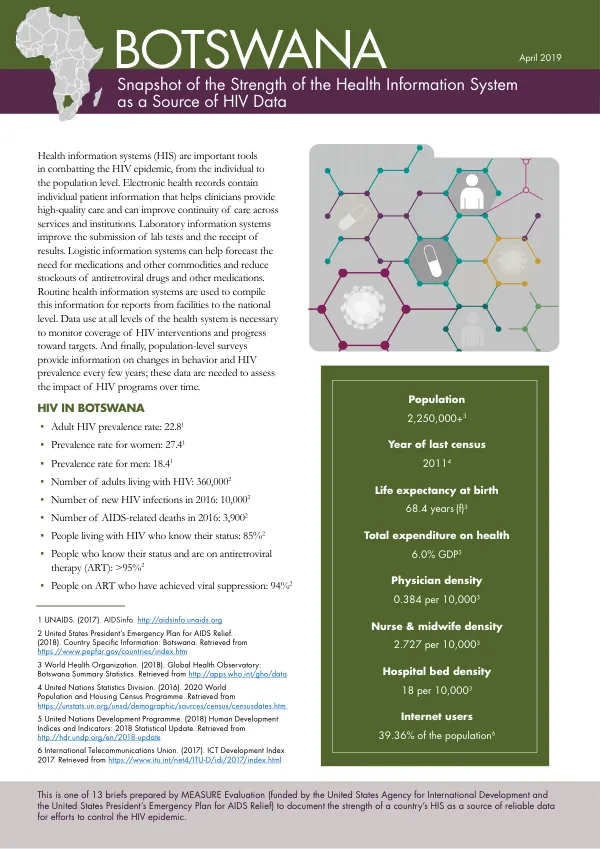
Snapshot of the Strength of the Health Information System as a Source of HIV Data in Botswana
Sign inCAROLINA POPULATION CENTER AT THE UNIVERSITY OF NORTH CAROLINA AT CHAPEL HILL
Snapshot of the Strength of the Health Information System as a Source of HIV Data in Botswana
Botswana's health information system (HIS) plays a crucial role in combatting the HIV epidemic.
2019 · 4 pages
Sign in to readA free account is required to download.
Abstract
The country's adult HIV prevalence rate is 22.81%, with a higher prevalence rate among women at 27.41%. The number of adults living with HIV is estimated to be 360,000, with 10,000 new infections and 3,900 AIDS-related deaths in 2016. The majority of people living with HIV, 85%, know their status, and over 95% of those on antiretroviral therapy (ART) have achieved viral suppression. Botswana's HIS has several strengths, including a 91% completion rate for electronic system for routine site-level data and a 98% availability of health statistics office. The country also has a 67% data quality assessment aligned with the health sector strategy. However, there are areas for improvement, such as the 7% completeness of vital registration for births and deaths, and the 28% availability of disease surveillance reporting. The Integrated Health Service Plan: A Strategy for Changing the Health Sector for Healthy Botswana 2010-2020 outlines the HIS strategy, which includes six objectives to address the fragmented and overloaded HIS. The plan aims to create an enabling environment for efficient monitoring and evaluation of the implementation and achievements of the integrated health service plan. The six objectives have strategic actions that center on addressing the HIS, including agreeing on core indicators, updating and harmonizing data collection tools, and developing systems for the collection, collation, and timely analysis of data. Botswana's HIV testing data is sparse, with the last Demographic and Health Survey report completed in 1988 and the last Multiple Indicator Cluster Survey completed in 2000. However, the 2014 Progress Report on the National Response to the 2011 Declaration of Commitments on HIV and AIDS indicates that 63.7% of adults ages 15-49 years were tested for HIV and received their results. The report also estimated that 94.3% of pregnant women were tested for HIV during prenatal and postnatal care for 2014. The country's eHealth strategy, outlined in the eHealth Strategy of Botswana 2016-2020, aims to improve the use of information and communication technologies to support the delivery of health services. The strategy includes several objectives, such as improving the availability and accessibility of health information, and enhancing the quality and timeliness of health data. Botswana's HIS has several indicators that are available and current, including the percentage of facilities represented in health management information system reports, which is 74%. The country also has a 98% availability of measles coverage reported to the World Health Organization (WHO)/UNICEF. However, there are areas for improvement, such as the 28% availability of data on the number of institutional deliveries by district and published within a year. The country's health statistics office is available online, and the annual health statistics report is published. However, the report is only available 9% of the time. The country also has a 49% availability of population census within the past 10 years, and a 100% availability of national health surveys.
Related documents