USAID DEC
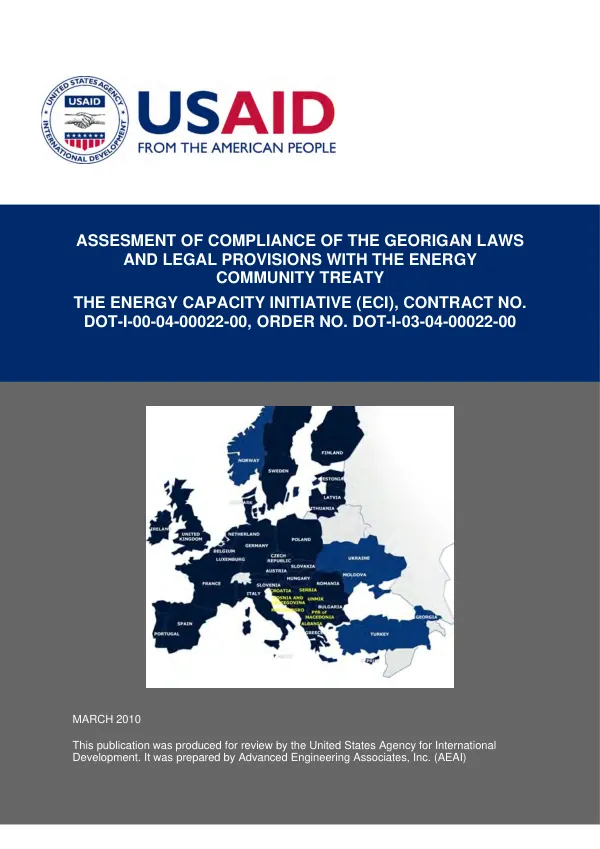
Assessment of Compliance of The Georgian Laws and Legal Provisions with The Energy Community Treaty
Sign inADVANCED ENGINEERING ASSOCIATES INTERNATIONAL, INC. /SGGA
Assessment of Compliance of The Georgian Laws and Legal Provisions with The Energy Community Treaty
The Energy Capacity Initiative (ECI) was established to assess the compliance of Georgian laws and legal provisions with the Energy Community Treaty.
2010 · 118 pages
Sign in to readA free account is required to download.
Abstract
The ECI, Contract No. DOT-I-00-04-00022-00, Order No. DOT-I-03-04-00022-00, aimed to evaluate the alignment of Georgian legislation with the European Union's (EU) energy acquis communautaire. The assessment focused on the electricity and natural gas markets, as well as other key issues such as competition, environment, and renewable energy. The Treaty establishing the Energy Community was signed on 25 October 2005 in Athens by the European Community and nine Contracting Parties from South East Europe. The Treaty entered into force on 1 July 2006, with the aim of creating a stable regulatory and market framework capable of attracting investment in gas networks, power generation, and transmission and distribution networks. The Contracting Parties agreed to implement core parts of the EC acquis communautaire, including sector-specific and general documents. The assessment of compliance with the Energy Community Treaty focused on several key areas. In the electricity market, the assessment evaluated the compliance of Georgian laws and regulations with the Electricity Market Directive (2003/54/EC) and the Regulation (EC) No. 1228/2003. The assessment found that Georgia's legal framework for the electricity market was largely in line with the EU's acquis, but some gaps and inconsistencies remained. Specifically, the assessment noted that Georgia's public service obligations and customer protection provisions were not fully aligned with the EU's directives. In the natural gas market, the assessment evaluated the compliance of Georgian laws and regulations with the Natural Gas Market Directive (2003/55/EC) and the Regulation (EC) No. 1775/2005. The assessment found that Georgia's legal framework for the natural gas market was largely in line with the EU's acquis, but some gaps and inconsistencies remained. Specifically, the assessment noted that Georgia's monitoring of security of supply and access to accounts provisions were not fully aligned with the EU's directives. The assessment also evaluated Georgia's compliance with other key issues, including competition, environment, and renewable energy. The assessment found that Georgia's competition authority and state aid provisions were largely in line with the EU's acquis, but some gaps and inconsistencies remained. Specifically, the assessment noted that Georgia's cartel prohibition and prohibition of abuses of dominant positions provisions were not fully aligned with the EU's directives. In terms of environmental protection, the assessment found that Georgia's legislation on emissions from large combustion plants and integrated pollution prevention and control was largely in line with the EU's acquis. However, some gaps and inconsistencies remained, particularly with regard to the conservation of wild birds and the promotion of renewable energy. The assessment concluded that while Georgia's legislation was largely in line with the EU's energy acquis, some gaps and inconsistencies remained. The report provided recommendations for Georgia to address these gaps and inconsistencies, with the aim of enhancing its compliance with the Energy Community Treaty and promoting a more stable and competitive energy market. The assessment was conducted by Advanced Engineering Associates International, Inc. (AEAI) under the Energy Capacity Initiative (ECI), Contract No. DOT-I-00-04-00022-00, Order No. DOT-I-03-04-00022-00. The assessment was produced for review by the United States Agency for International Development (USAID).