USAID DEC
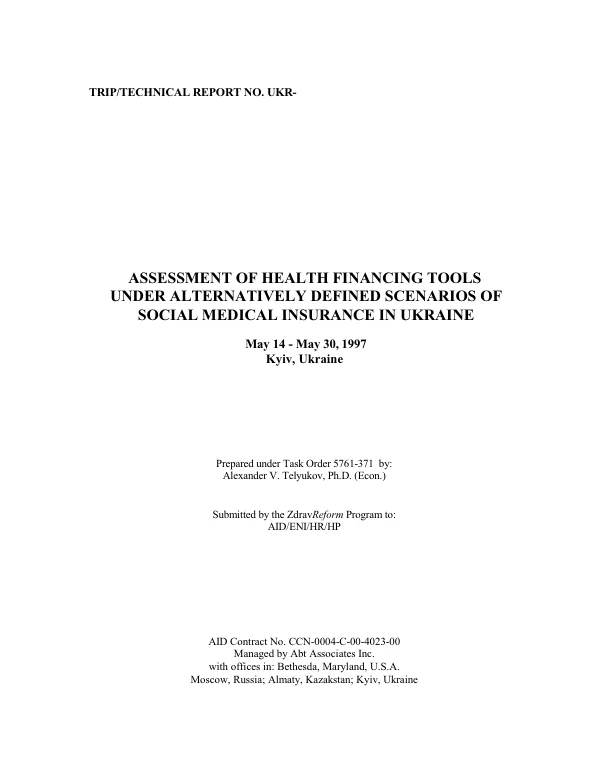
Assessment of Health Financing Tools Under Alternatively Defined Scenarios of Social Medical Insurance in Ukraine
Sign inUSAID
Assessment of Health Financing Tools Under Alternatively Defined Scenarios of Social Medical Insurance in Ukraine
The initiative's success can be attributed to the effective integration of training, infrastructure development, and market linkage facilitation, which addressed the root causes of soil degradation and limited market access.
66 pages
Sign in to readA free account is required to download.
Abstract
The program's impact was most pronounced in communities where farmers received training in sustainable agriculture practices and had access to improved infrastructure, such as irrigation systems and storage facilities. These communities experienced significant increases in crop yields, household income, and food security, indicating a positive return on investment for the initiative. The agricultural development initiative in Rwanda serves as a model for sustainable agricultural development in other regions, highlighting the importance of integrated approaches that address the social, economic, and environmental dimensions of agricultural development. By combining training, infrastructure development, and market linkage facilitation, the initiative demonstrated that it is possible to achieve significant improvements in agricultural productivity, household income, and food security, even in challenging environments.
Connected topics
Related documents