USAID. MISSION TO BOLIVIA
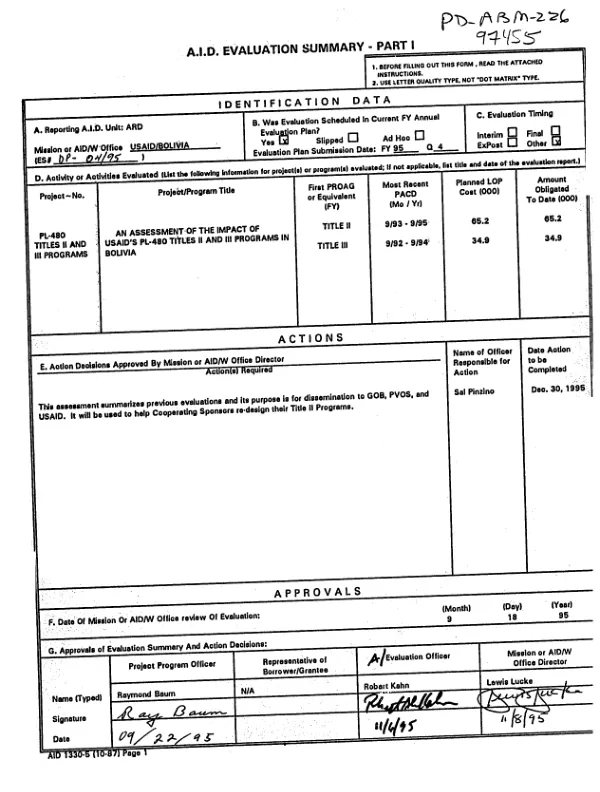
Assessment of the impact of USAID"s PL-480 Titles II and III programs in Bolivia
Summarizes attached assessment (XD-ABM-226-A) of previous evaluations of the impact of Title II and Title III programs on the poor in Bolivia.
1995
Sign in to readA free account is required to download.
Abstract
The assessment covered the period 1989-1994. Both programs have had significant impacts in a variety of areas. In terms of food production and availability and related economic opportunity, Title III has saved the Government of Bolivia (GOB) an average of $18 million a year in foreign exchange; added an average of 118-214 calories per person per day to the Bolivian diet; tripled wheat production, raising local production to more than 17.4% of total national consumption; increased agricultural production and sales for over 100,000 farm families; encouraged a new legal structure for land ownership that would remove constraints to agricultural growth; and achieved more sustainable use of natural resources. Title II has increased agricultural production in 400-500 poor rural communities a year, while Title III has provided agricultural production credit to 65,000 farm families. The program also funded the construction of a number of irrigation systems, access roads, and other agricultural infrastructure, directly increasing production and sales for over 50,000 farm families. Title III funded the production and distribution of certified seeds and established regional seed councils for quality control and certification. These initiatives are expected to promote agro-forestry and improve silviculture and farming practices to ensure long-run food availability. Title II resources have also significantly improved access to food. They have supported agricultural development in poor rural areas; supported safety net programs of food security; and supported women"s economic development. The Title II Municipal Food for Work Program (MFFW) pays unemployed workers in food to construct basic infrastructure, such as water lines, sanitary sewers, and paved streets in poor peri-urban areas. The value of the food paid does not exceed the minimum wage, and the beneficiaries are self-targeted. The program has created 104,062 person-years of employment for development projects, making accessible an additional 73,000 MTs of food during from FY91 to FY94. The school feeding program provided hot breakfasts and lunches for 230,000 primary school children, significantly increasing their daily calorie and protein requirements. Both Title II and III programs have improved food utilization and, consequently, family health. They have provided community health services and improved water and sanitation services; provided and/or improved primary health services in poor rural areas throughout Bolivia, reducing diarrheal diseases and respiratory infections in pre-school children; established growth monitoring of pre-school children; and helped rehabilitate malnourished children. Health interventions were targeted to the two populations most vulnerable to food insecurity: rural and peri-urban women and their children aged 0-6. The Title II Integrated Child Survival Program provided child survival services in more than 700 poor rural communities each year, focusing on preventable factors most statistically significant in causing infant and child mortality and morbidity within the most vulnerable subpopulations. The Title III Health Program has financed all or part of three projects -- Community and Child Health, Extended Program of Immunization, and Control of Communicable Diseases -- which have shown impressive results in reducing infant, child, and maternal morbidity and mortality and malnutrition. Largely due to the Title II and III health projects, the infant mortality rate in rural areas has fallen from 167-245/1,000 in 1988 to 75/1,000 in 1994, and the child mortality rate from 168.4 to 116/1,000. Finally, the programs have contributed to democratic development and environmental protection. The Title II MFFW program has increased citizen participation in municipal decisionmaking by allowing citizens to select the public work they wish to construct for their neighborhood. The Title III program provided key leadership in establishing policies and programs to reduce degradation of soil, water, and forests and to protect biological diversity. The program provided assistance to fledgling NGOs and other civic organizations, established a national environmental fund, provided support for maintaining national parks and forest reserves, and promoted the development and enactment of key environmental laws and policies.