ABT ASSOCIATES
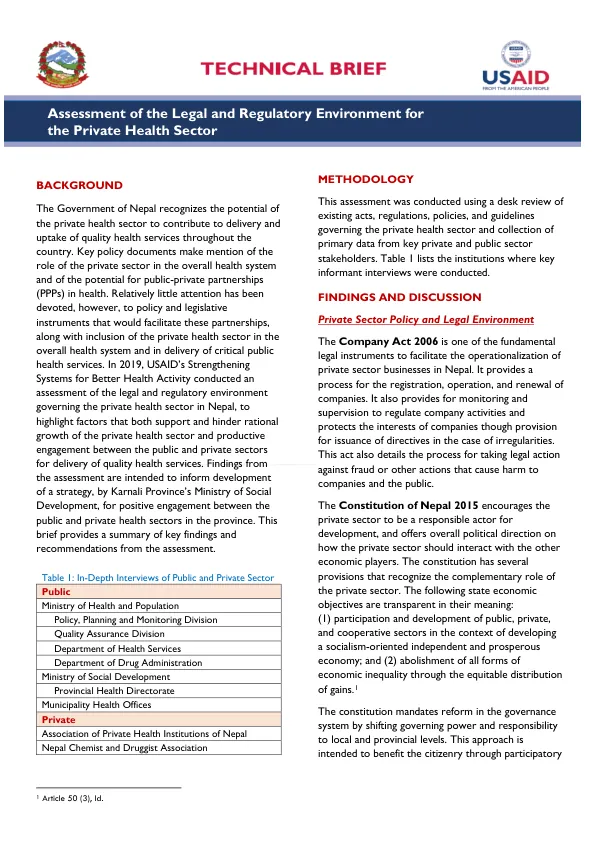
Assessment of the Legal and Regulatory Environment for the Private Health Sector
The Government of Nepal recognizes the potential of the private health sector to contribute to delivery and uptake of quality health services throughout the country.
2023 · 4 pages
Sign in to readA free account is required to download.
Abstract
Key policy documents make mention of the role of the private sector in the overall health system and of the potential for public-private partnerships (PPPs) in health. The Company Act 2006 is one of the fundamental legal instruments to facilitate the operationalization of private sector businesses in Nepal, providing a process for registration, operation, and renewal of companies, as well as monitoring and supervision to regulate company activities. The Constitution of Nepal 2015 encourages the private sector to be a responsible actor for development, offering overall political direction on how the private sector should interact with other economic players. The constitution has several provisions that recognize the complementary role of the private sector, including participation and development of public, private, and cooperative sectors in the context of developing a socialism-oriented independent and prosperous economy. The Public-Private Partnership (PPP) Policy 2015 aims to create an attractive environment for private investment in the development and reconstruction of public infrastructure and services, utilizing professionalism, work efficiency, entrepreneurship, and technical skills of the private sector to provide quality public services. The Public-Private Partnership and Investment Act 2018 provides an important legislative basis for institutionalizing PPPs, authorizing all tiers of government to implement projects in the PPP model in accordance with their mandate and competence. The Local Government Operation Act 2017 references coordination, collaboration, and partnership with the private sector in delivering local public services, including delivery of basic health services and sanitation, and disaster management and response. The act provides opportunity for the private sector to engage in service delivery. The National Health Sector Strategy (NHSS) 2015-2020 envisions health as a fundamental right of every citizen by ensuring access to quality health services delivered through equitable and accountable health systems. The NHSS supports expansion of partnerships between the public and private sectors, while strengthening the institutional capacity of the Ministry of Health and Population (MoHP) to better regulate public and private health institutions. The National Health Policy 2019 emphasizes the right to health, federalization of the health sector, and enhancing public investment in the health sector, supporting partnerships and collaboration with the private health sector, and promoting a service-oriented private sector. However, inconsistent policies on investment in private sector health and complicated regulatory mechanisms pose challenges for the private health sector. Multiple regulatory mechanisms impact private health entities, and the absence of coordination between these bodies subjects private health institutions to complex and sometimes lengthy administrative procedures, limiting opportunities for business growth. Private facility owners and managers find it challenging to adhere to all of the regulatory guidelines, codes, and standards that they are subject to, which are demanding and complex, yet not regularly enforced due to the lack of routine monitoring and inspection.