ABT ASSOCIATES
Technical Brief - Health Care Waste Management in Surkhet Provincial Hospital
Health Care Waste Management in Surkhet Provincial Hospital began in May 2019 with support from USAID's Strengthening Systems for Better Health Activity, provided through the Health Care Foundation of Nepal (HECAF).
2023 · 2 pages
Sign in to readA free account is required to download.
Abstract
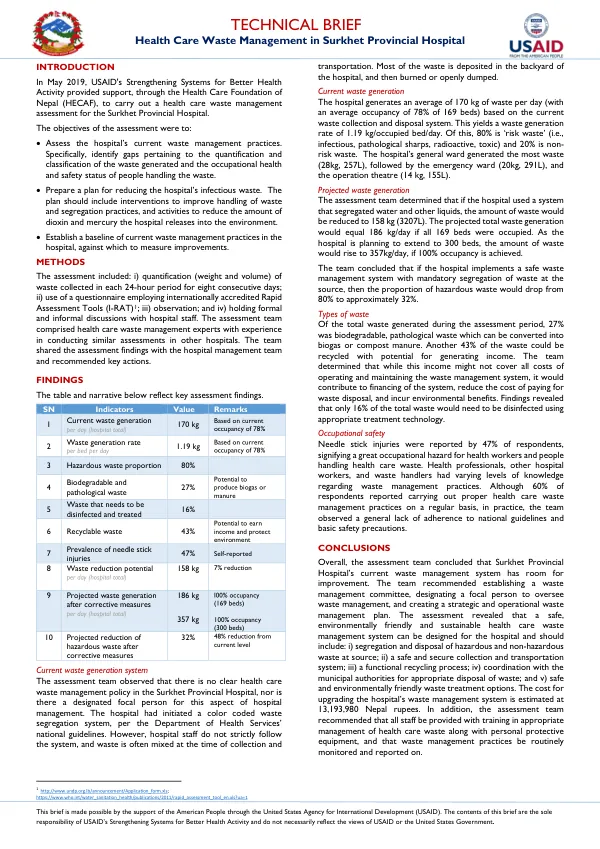
The objectives of the assessment were to assess the hospital's current waste management practices, identify gaps, and prepare a plan for reducing infectious waste. The plan aimed to improve handling and segregation practices, reduce dioxin and mercury emissions, and establish a baseline for measuring improvements. The assessment included quantification of waste collected over eight consecutive days, use of internationally accredited Rapid Assessment Tools (I-RAT), observation, and formal and informal discussions with hospital staff. The assessment team comprised health care waste management experts with experience in conducting similar assessments in other hospitals. The team shared the assessment findings with the hospital management team and recommended key actions. Key assessment findings included a current waste generation rate of 170 kg per day, with 80% classified as 'risk waste' and 20% as non-risk waste. The hospital's general ward generated the most waste, followed by the emergency ward and the operation theatre. The assessment team determined that if the hospital implemented a safe waste management system with mandatory segregation of waste at the source, the proportion of hazardous waste would drop from 80% to approximately 32%. Biodegradable and pathological waste accounted for 27% of the total waste, with potential for conversion into biogas or compost manure. Recyclable waste made up 43% of the total waste, with potential for generating income. The assessment revealed a high prevalence of needle stick injuries, reported by 47% of respondents, indicating a significant occupational hazard for health workers and people handling health care waste. Health professionals, other hospital workers, and waste handlers had varying levels of knowledge regarding waste management practices. The team observed a general lack of adherence to national guidelines and basic safety precautions. The assessment team concluded that Surkhet Provincial Hospital's current waste management system has room for improvement. Recommendations included establishing a waste management committee, designating a focal person to oversee waste management, and creating a strategic and operational waste management plan. The assessment revealed that a safe, environmentally friendly, and sustainable health care waste management system can be designed for the hospital, including segregation and disposal of hazardous and non-hazardous waste at source, a safe and secure collection and transportation system, a functional recycling process, coordination with municipal authorities for waste disposal, and safe and environmentally friendly waste treatment options. The estimated cost for upgrading the hospital's waste management system is 13,193,980 Nepal rupees.