USAID DEC
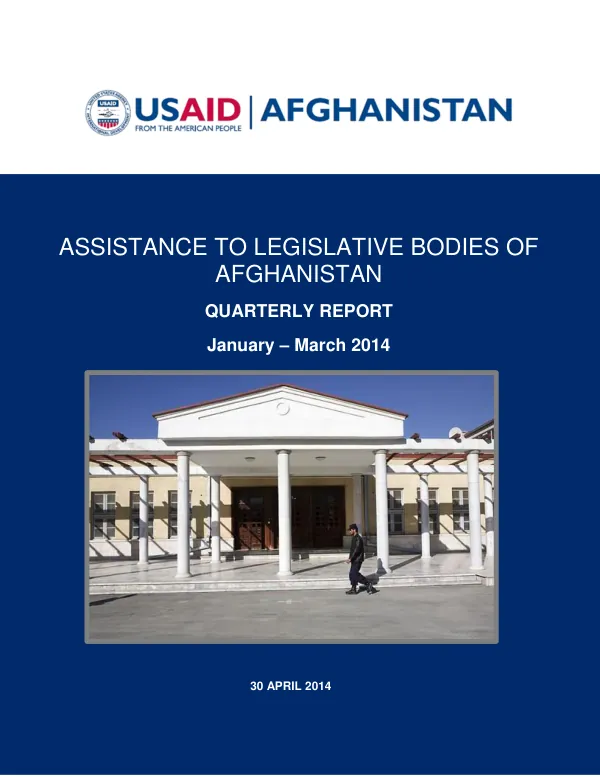
Assistance to Legislative Bodies of Afghanistan (ALBA) Quarterly Report: January to March 2014
Sign inCOUNTER PART INTERNATIONAL
Assistance to Legislative Bodies of Afghanistan (ALBA) Quarterly Report: January to March 2014
The Assistance to Legislative Bodies of Afghanistan (ALBA) project is a four-year technical assistance initiative funded by the United States Agency for International Development (USAID), implemented by Development Alternatives, Inc.
2014 · 83 pages
Sign in to readA free account is required to download.
Abstract
(DAI). The project aims to support the development of the Afghan Parliament to enable it to operate as an independent and effective legislative, representative, and oversight body. The project's overarching Assistance Objective (AO) 1 for Democracy and Governance in Afghanistan is "Improved performance and accountability of governance." Five intermediate results (IRs) comprise this AO, with ALBA supporting the third IR, "Strengthened governance and service delivery at national and sub-national levels." The project's four key areas of focus are Legislative Support, Oversight, Outreach, and Institutional Development of the Parliament, with a major focus on the commissions as a vehicle for many of ALBA's activities. USAID designed ALBA to prepare both Houses of Parliament for greater self-reliance, building on the foundation of USAID's previous programs while expanding support to the Meshrano Jirga (MJ). Capacity development aimed at immediate and long-term application for practical, on-the-job learning as Members of Parliament (MPs) and staff reduce reliance on embedded advisors and engage in legislative, oversight, and outreach activities alongside government, civil society, and private sector actors. During the report period, which largely coincided with the Fall/Winter parliamentary recess, activities and progress were witnessed in all four major objectives of ALBA. Under Objective One – Strengthened Legislative Processes, ALBA worked with the HR Directorates of both Houses to conclude an agreement on an interim curriculum for a series of intensive seminars on parliamentary operations and concepts. These seminars were conducted between 27 January and 2 March 2014, ranging from media and camera techniques for the Directorate of Information and Public Relations (DIPR) to a more broad-ranging seminar on Legislative Policy. Under Objective Two – Improved Oversight, ALBA continued supporting the development of the Parliamentary Anti-Corruption Caucus (PACC), establishing relations between the group and the Independent Anti-Corruption Monitoring and Evaluation Committee (MEC), which included a formal session with the MEC Board of Directors. ALBA also continued working with the group to develop its internal organization, its formal charter, and other foundation documents. Additionally, ALBA supported the Wolesi Jirga (WJ) Women's Commission, working with it to plan its priorities for the next three months and preparing the Commission's annual report, including the Commission's efforts in the areas of outreach and gender budget analysis. Under Objective Three – Increased Outreach, ALBA shared its concept for revisions to the parliamentary website with the Head of the WJ Parliamentary Affairs Directorate, which recommends incorporating features such as live audio and video web-streaming of plenary sessions and dedicated pages for citizens' petitions and complaints. There was additional discussion about reviving the Legislative Tracking Website and Proceedings Reporting/Recording, including plans to conduct an assessment of the existing systems and processes. ALBA continued its outreach to civil society organizations (CSOs), focusing on efforts to monitor the development and final passage of the Criminal Procedures Code, which generated considerable controversy over the impact of provisions. Under Objective Four – Increased Institutional Development, ALBA continued the provision of basic language and IT courses for staff and members of both Houses. The process of integrating the staff of the capacity-building sections into Afghanistan Parliamentary Institute (API) planning and operations was finalized through the development of a comprehensive interim seminar series for staff conducted during the parliamentary recess of 21 January to 6 March. During the API seminar series, ALBA conducted workshops on UN Resolution 1325, the Role of Women in Conflict Resolution and Security, and an overall Gender Workshop. Efforts to develop a gender strategy involving both Houses began during this period, with joint planning sessions.