USAID DEC
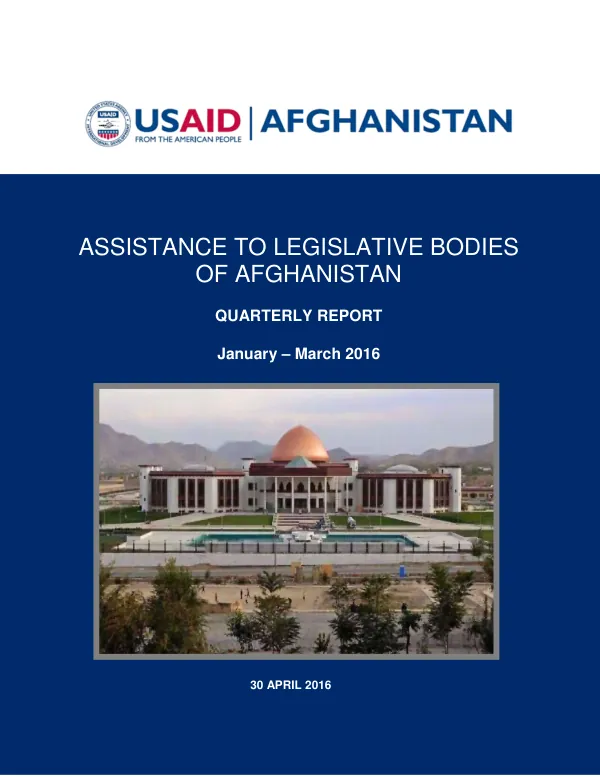
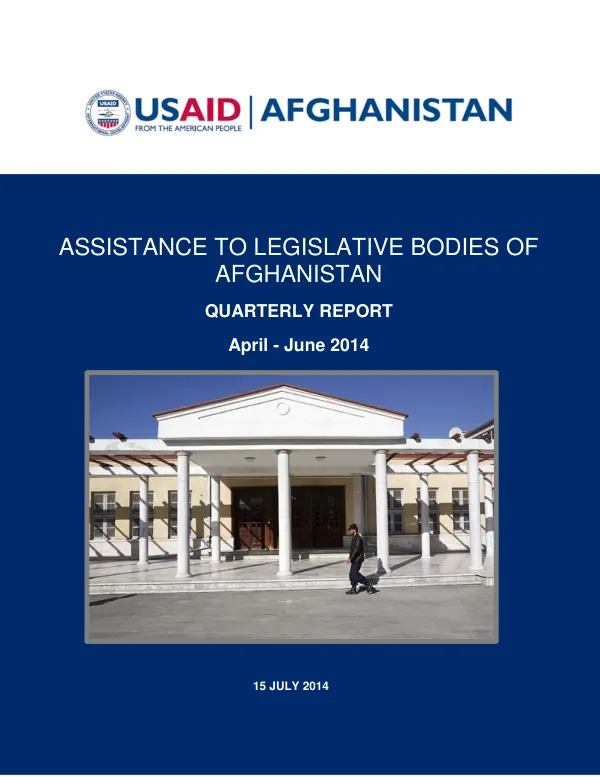
Assistance to Legislative Bodies of Afghanistan (ALBA) Quarterly Report: April to June 2014
Sign inCOUNTER PART INTERNATIONAL
Assistance to Legislative Bodies of Afghanistan (ALBA) Quarterly Report: April to June 2014
The Assistance to Legislative Bodies of Afghanistan (ALBA) project is a four-year technical assistance initiative funded by the United States Agency for International Development (USAID), implemented by Development Alternatives, Inc.
2014 · 72 pages
Sign in to readA free account is required to download.
Abstract
(DAI). The project aims to support the development of the Afghan Parliament to enable it to operate as an independent and effective legislative, representative, and oversight body. The project's overarching Assistance Objective (AO) 1 for Democracy and Governance in Afghanistan is "Improved performance and accountability of governance." Five intermediate results (IRs) comprise this AO, with ALBA supporting the third IR, "Strengthened governance and service delivery at national and sub-national levels." The project focuses on four key areas: Legislative Support, Oversight, Outreach, and Institutional Development of the Parliament, with a major focus on the commissions as a vehicle for many of ALBA's activities. USAID designed ALBA to prepare both Houses of Parliament for greater self-reliance, building on the foundation of USAID's previous programs while expanding support to the Meshrano Jirga (MJ). This approach includes capacity development aimed at immediate and long-term application for practical, on-the-job learning as Members of Parliament (MPs) and staff reduce reliance on embedded advisors and engage in legislative, oversight, and outreach activities alongside government, civil society, and private sector actors. During the report period, the ALBA program supported the development of the Afghan Parliament, particularly in the areas of legislative processes, oversight, and outreach. Under Objective One – Strengthened Legislative Processes, ALBA launched its first Commission Support Unit (CSU) to assist commissions of the National Assembly in improving their legislative and oversight processes. The CSU conducted research and analysis for pending priority legislation, assisted commissions in preparing analytical reports, and held hearings on the legislation. This approach enabled ALBA to play a key role in the passage of the Anti-Money Laundering Law and Countering the Finance of Terrorism Law in June. Under Objective Two – Improved Oversight, ALBA continued support to the Parliamentary Anti-Corruption Caucus, which reviewed and led the effort to pass the draft Access to Information Law. With ALBA support, the PACC expanded their caucus to the Upper House, and seven Senators received membership. This development is crucial in building a critical mass of advocates in both Houses for both the current anti-corruption legislation and other key Parliamentary initiatives in this area. Under Objective Three – Increased Outreach, ALBA supported the MJ Commission on Legislative Affairs, Justice, and Judiciary provincial oversight trip to Herat. A large component of the trip was the CSO roundtable with the Senators, which 83 individuals representing a wide variety of CSOs in the western region attended. The event generated considerable national attention and highlighted the importance of civil society engagement in the legislative process. The ALBA program also underwent significant changes internally, with the departure of the ex-pat DCOP and the arrival of the local Afghan DCOP. Additionally, with generous additional support from the UK Embassy, ALBA was able to expand in certain critical areas of programming, including efforts in anti-corruption and expansion of oversight activities both in the provinces and the capital. The Presidential and Provincial Council elections held in early April 2014 significantly disrupted the work of the Parliament, but the ALBA program continued to support the development of the Afghan Parliament, despite these challenges.