USAID DEC
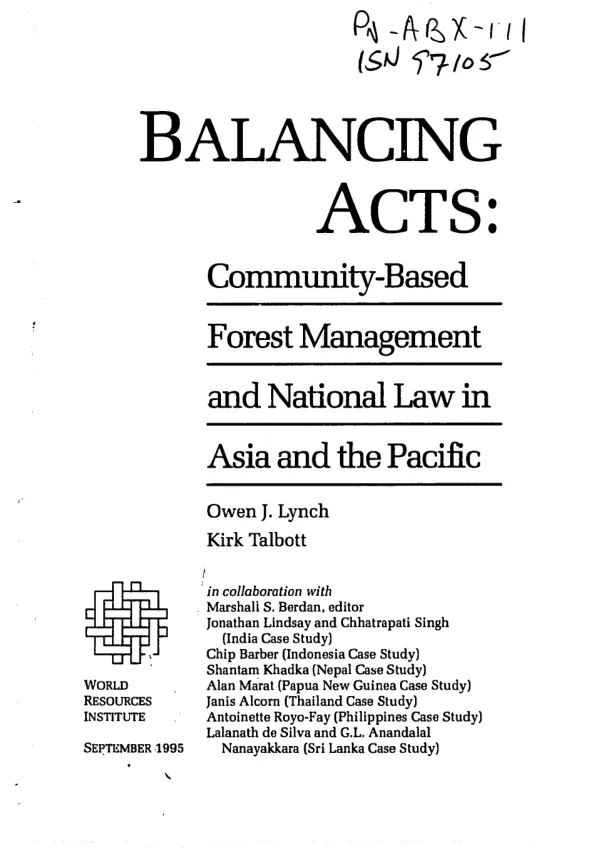
Balancing acts : community-based forest management and national law in Asia and the Pacific
Sign inWORLD RESOURCES INSTITUTE (WRI)
Balancing acts : community-based forest management and national law in Asia and the Pacific
Most national governments in tropical Asia still maintain centralized forest-ownership systems inherited from colonialism, ignoring the rights of the forest-dwelling communities who traditionally have sustained the forests in the region.
Lynch, Owen J.; Talbott, Kirk · 1995
Sign in to readA free account is required to download.
Abstract
This report, based on 5 years of research, surveys the historical antecedents and contemporary status of national laws and policies affecting forests and forest-dwellers in India, Indonesia, Nepal, the Philippines, Sri Lanka, Thailand, and more briefly, Papua New Guinea, seven countries which reflect the various legal, historical, and cultural settings under which community-based forest management initiatives are being forged -- and, more importantly, as environmental conditions deteriorate, being revised. Papua New Guinea, it is noted, is unique for its exemplary constitutional recognition of community-based management rights that promote wider distribution of forestry"s benefits (but don"t necessarily ensure sustainable or equitable forest management practices). The report discusses emerging community-based management programs and reviews the theoretical framework for private, community-based property rights. It also presents model legal instruments, along with recommendations for promoting sustainable community-based forest management. Includes bibliography (pp. 167-187). (Author abstract, modified)
Connected topics