USAID DEC
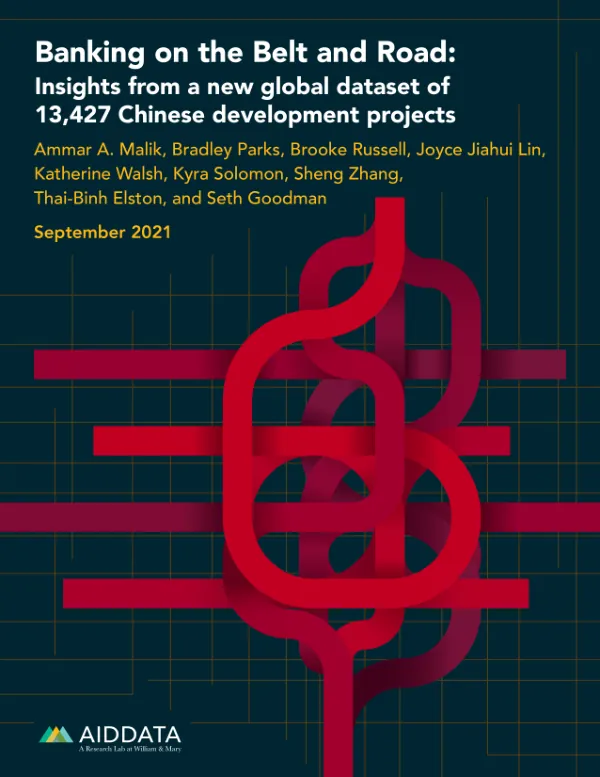
Banking on the Belt and Road: Insights from a new global dataset of 13,427 Chinese development projects
Sign inFORD FOUNDATION
Banking on the Belt and Road: Insights from a new global dataset of 13,427 Chinese development projects
China's Belt and Road Initiative (BRI) has been a significant development in international finance, with China providing record amounts of international development finance to low- and middle-income countries (LMICs).
2021 · 166 pages
Sign in to readA free account is required to download.
Abstract
The initiative has been shrouded in secrecy, with grant-giving and lending activities remaining opaque. A new dataset of 13,427 Chinese development projects, worth $843 billion, has been compiled to provide insights into China's overseas development finance program. The dataset captures projects across 165 countries in every major world region over an 18-year period. The data reveals an extraordinary expansion in China's overseas development finance program during the first two decades of the 21st century. China's annual international development finance commitments have hovered around $85 billion a year, outspending the U.S. and other major powers on a 2-to-1 basis or more. The majority of China's international development finance is in the form of semi-concessional and non-concessional debt rather than aid. State-owned commercial banks have assumed an increasingly important role in China's overseas development finance program, organizing lending syndicates and other co-financing arrangements to undertake bigger-ticket infrastructure projects. The number of "mega-projects" financed with loans worth $500 million or more has tripled during the first five years of BRI implementation. Collateralization has become a key safeguard in China's high-risk, high-reward credit allocation strategy, with foreign currency-denominated loans to resource-rich countries collateralized against future commodity export receipts. The implementation of the BRI has marked a significant transition in how China bankrolls infrastructure projects. The majority of its overseas lending was directed to sovereign borrowers during the pre-BRI era, but nearly 70% is now directed to state-owned companies, state-owned banks, special purpose vehicles, joint ventures, and private sector institutions. These debts do not appear on government balance sheets in LMICs but benefit from explicit or implicit forms of host government liability protection, introducing major public financial management challenges. The dataset reveals that 42 LMICs now have levels of debt exposure to China in excess of 10% of GDP. These debts are systematically underreported to the World Bank's Debtor Reporting System (DRS) because central government institutions in LMICs are not the primary borrowers responsible for repayment. The average LMIC government is estimated to be underreporting its actual and potential repayment obligations to China by an amount equivalent to 5.8% of its GDP. Collectively, these underreported debts are worth approximately $385 billion. The BRI infrastructure project portfolio has encountered major implementation problems, such as corruption scandals, labor violations, environmental hazards, and public protests. However, BRI infrastructure projects are less likely to face problems during implementation when undertaken by host country organizations or organizations that are neither from China nor host countries.