USAID DEC
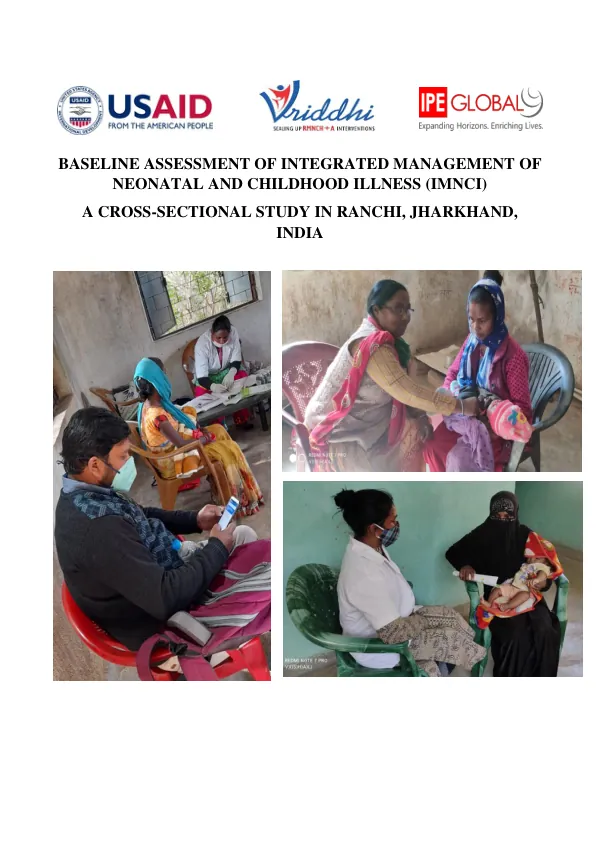
Baseline Assessment of Integrated Management of Neonatal and Childhood Illness (IMNCI) in Ranchi, Jharkhand, India
Sign inUSAID
Baseline Assessment of Integrated Management of Neonatal and Childhood Illness (IMNCI) in Ranchi, Jharkhand, India
The Integrated Management of Neonatal and Childhood Illness (IMNCI) initiative in Ranchi district of Jharkhand, India, aims to improve the health and well-being of newborns and children under the age of five.
2021 · 67 pages
Sign in to readA free account is required to download.
Abstract
The initiative is a collaborative effort between various stakeholders, including the government, non-profit organizations, and international agencies. The study area consists of three blocks: Angara, Ratu, and Namkum. The study objectives are to assess the knowledge and perception of Auxiliary Nurse Midwives (ANMs) and Medical Officers (MOs) regarding IMNCI programmatic work, to observe clinical case management practices by ANMs and MOs, and to understand the mothers' and caregivers' understanding of health for their under-five children. The study methodology involves a cross-sectional survey, where data was collected from 30 ANMs and 30 MOs, and 120 mothers and caregivers. The survey included questions on knowledge and perception of IMNCI, clinical case management practices, and mothers' and caregivers' understanding of health for their under-five children. The study findings indicate that ANMs and MOs have a good understanding of IMNCI, but there is a need for improvement in their knowledge and skills. The clinical case management practices observed by ANMs and MOs were found to be satisfactory, but there were some gaps in the management of acute respiratory infections and diarrhea. The mothers and caregivers showed a good understanding of health for their under-five children, but there were some misconceptions regarding the management of common illnesses. The study also found that the availability of medicines and equipment in health facilities was satisfactory, but there were some gaps in the availability of essential medicines and equipment. The study concludes that there is a need for strengthening the IMNCI initiative in Ranchi district, particularly in terms of improving the knowledge and skills of ANMs and MOs, and enhancing the availability of medicines and equipment in health facilities. The study highlights the importance of IMNCI in reducing morbidity and mortality among newborns and children under the age of five. The study also emphasizes the need for continued support and collaboration among stakeholders to improve the health and well-being of this vulnerable population. The study area, Ranchi district, is a rural area with a high burden of neonatal and childhood illnesses. The district has a total population of approximately 2.5 million, with a high percentage of under-five children. The study was conducted in three blocks, which are representative of the district's rural and urban areas. The study's findings have implications for policy and programmatic interventions aimed at improving the health and well-being of newborns and children under the age of five in Ranchi district. The study's recommendations include strengthening the IMNCI initiative, improving the knowledge and skills of ANMs and MOs, and enhancing the availability of medicines and equipment in health facilities. The study's methodology and findings are consistent with the existing literature on IMNCI and its implementation in India. The study's results are also consistent with the World Health Organization's (WHO) guidelines for IMNCI. The study's conclusions and recommendations are based on the study's findings and are consistent with the existing evidence on IMNCI. The study's limitations include the small sample size and the cross-sectional design, which may not capture the dynamics of IMNCI implementation in the study area. However, the study's findings are consistent with the existing literature and provide valuable insights into the implementation of IMNCI in Ranchi district.