USAID
Managing High Risk Pregnancies in Himachal Pradesh
High Risk Pregnancies in Himachal Pradesh are cases where pre-existing or newly developed conditions put the pregnancy at increased risk of complications.
2021 · 26 pages
Sign in to readA free account is required to download.
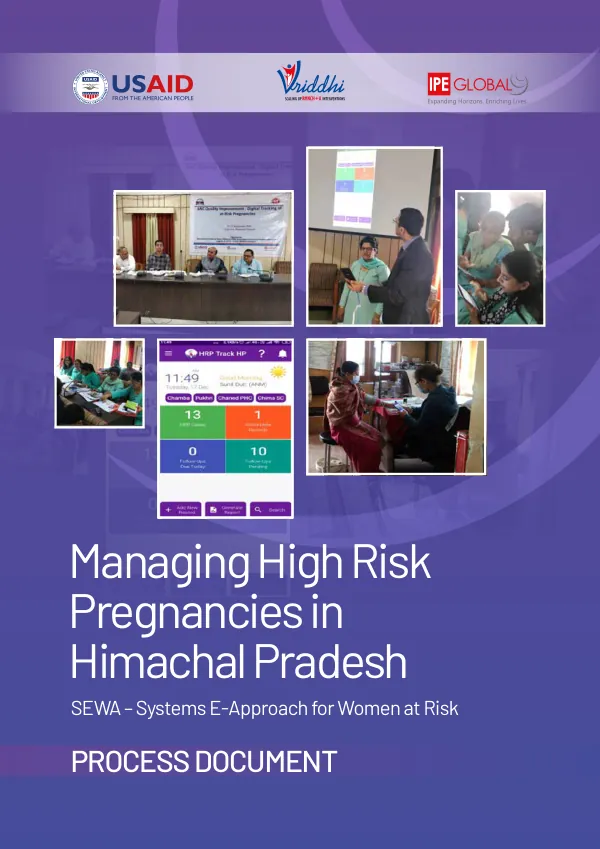
Abstract
Early identification and appropriate management, including referral, of such conditions is key to the safety of the mother and the newborn's survival. In the absence of a pre-existing HRP implementation model in the country, USAID Vriddhi in collaboration with the Government of Himachal Pradesh developed a new digital HRP management model called 'SEWA – A System E-approach for Women at risk'. The development and pilot of SEWA demonstrates a sustainable and scalable model for early identification and line listing of high-risk pregnant women with appropriate referral and increased engagement with healthcare workers using a digital tool in the form of an android app. SEWA was implemented as a pilot intervention in two community development blocks of district Chamba, a mountainous terrain with limited geographical access and reported low HRP identification of 3.5% in the year 2018-19. The key steps in the development and pilot implementation of SEWA included finalizing protocols for identification of HRPs, defining process and roles, mapping health facilities, setting up the communication loop, and development of a digital solution. The digital app, used by ANMs and program officers, tracked pregnant women for a year and recorded ANC visits, referrals, and birth outcomes. The use of digital solution for HRP was intended to enhance operational scope, improve efficiency, and ensure greater equity in the delivery of MNCH services. The intervention year reflected a rise in identification of HRP to 27.9%. A total of 1340 high-risk pregnant women were identified, with 2559 conditions tagged to them categorized into current pregnancy, previous pregnancy, and any existing chronic illness. The application recorded 53% outcomes for HRP with digital birth preparedness plans prepared and shared with pregnant women and ASHA by text message for compliance. For referral and referral compliance, the text message was sent by SEWA app to Pregnant Women (PW) and ASHA for compliance to referral visit. Majority of women who required urgent referral accessed referrals. Out of total 405-line listed PW with risk condition requiring referral, the application recorded 332 referrals for specialist care, with an appropriate referral rate of 82%. The SEWA application is a feasible and sustainable solution to complement the competency of healthcare providers for early identification of high-risk conditions and reduce the burden of preventable unprecedented deaths around the time of birth. Pregnancy is a natural, physiological process, yet nearly 32,000 women die annually in India during pregnancy and childbirth. High Risk Pregnancies (HRPs) are cases where pre-existing or newly developed conditions put the pregnancy at increased risk of complications. Early identification and appropriate management, including referral, of such conditions is key to their safety and to the newborn's survival. Antenatal care (ANC) is a potential opportunity for screening, diagnosis, health promotion, and disease prevention among pregnant women. The Ministry of Health and Family Welfare (MoHFW) recommends at least four ANC visits for routine examination, health promotion, as well as possible risk identification, stratification, and management. However, the NFHS 4 (2015-16) report shows low coverage of ANC, with only one in five pregnant women (21%) utilizing full ANC services. There was wide variation in ANCs across states, from as low as 2.3% to almost two-thirds (65.9%). Overall, half of the pregnant women (51.6%) had 4 or more ANC visits, less than one-third (30.8%) consumed IFA tablets for at least 100 days, and nine out of 10 (91.1%) had one or more doses of tetanus toxoid. Full ANC utilization varied based on place of residence, caste, and maternal education. Considering the unpredictable nature of the course of pregnancy and childbirth, early identification, timely referral, and management of High-risk pregnancies is of high importance to reduce maternal and neonatal mortality. The Government of India initiated the Pradhan Mantri Surakshit Matritva Abhiyan (PMSMA, 2016) and the Surakshit Matritva Aashwasan (SUMAN) to strengthen antenatal care. In particular, SUMAN seeks to 'end all preventable maternal and newborn deaths' and 'promote a positive birthing experience' by providing assured, dignified, and respectful delivery of quality healthcare services at no cost. It also has zero tolerance for denial of services to any woman and newborn at a public health facility. Considering the challenges of low ANC, limited capacity of frontline workers, and snow-bound terrain, Vriddhi worked with the government of Himachal Pradesh to develop a new model to identify and specifically manage HRPs. The state of Himachal Pradesh identified few gaps in their ANC practices, with the major gap being low capacity of Frontline Workers (FLW) i.e. Auxiliary Nurse Midwives (ANMs) to identify and 'line list' HR