USAID DEC
Limits of “Skills And Drills” Interventions to Improving Obstetric and Newborn Emergency Response: What More Do We Need to Learn?
Sign inJHPIEGO
Limits of “Skills And Drills” Interventions to Improving Obstetric and Newborn Emergency Response: What More Do We Need to Learn?
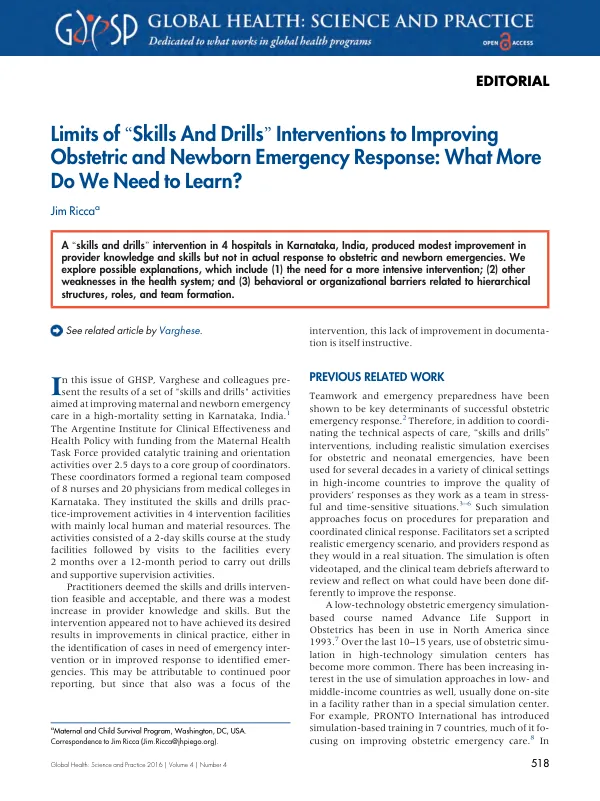
A "skills and drills" intervention in 4 hospitals in Karnataka, India, produced modest improvement in provider knowledge and skills but not in actual response to obstetric and newborn emergencies.
2016 · 4 pages
Sign in to readA free account is required to download.
Abstract
The intervention consisted of a 2-day skills course at the study facilities followed by visits to the facilities every 2 months over a 12-month period to carry out drills and supportive supervision activities. The intervention was based on the concept of teamwork and emergency preparedness, which have been shown to be key determinants of successful obstetric emergency response. Simulation approaches, including realistic simulation exercises for obstetric and neonatal emergencies, have been used for several decades in high-income countries to improve the quality of providers' responses as they work as a team in stressful and time-sensitive situations. Previous related work has demonstrated that simulation approaches can improve provider knowledge, skills, and confidence, but current evidence is thin that they improve provider practices, especially when implemented at larger scale. A Cochrane protocol is currently exploring this gap in knowledge. There is also interest in implementing simulations as they are usually done in low- and middle-income countries, which may give better results in terms of system-oriented improvements. Possible reasons for the limited effect of the intervention in India include the need for a more intensive intervention, other weaknesses in the health system, and behavioral or organizational barriers related to hierarchical structures, roles, and team formation. The authors suggest that the intervention did not address other systems weaknesses, such as commodity stock-outs or human resources shortages and turnover, which may have played a role in the lack of improved care. The diagnosis of reported complications was not better than the comparison facilities, suggesting that commodity issues do not fully account for the negative results. Providers told the mentoring teams that they only report emergencies when something is done, leaving open an important set of questions about provider recognition and intervention. Other possible explanations for the negative results include provider motivation and behavior, which may have been a well-designed and suitable intervention but was not reinforced by more frequent on-site, peer-to-peer mentoring. The intervention may have been on the right track, but the "dose" may have been too low to have the desired effect. Emergencies happen infrequently, are high-risk situations, and require rapid responses. In order to build confidence, the desired behavior may simply need to be modeled and practiced more often to truly cement it. The intervention did not effectively address important barriers to teamwork, such as how improvement goals are set and the presence of a flat, non-hierarchical organizational structure. Future investigations should systematically take account of other systems issues in order to better establish what incremental value there may be to a skills and drills intervention in terms of clinical practice improvement. The failure to show an effect on this primary outcome opens up a set of questions that future investigations ought to address.
Related documents