USAID DEC
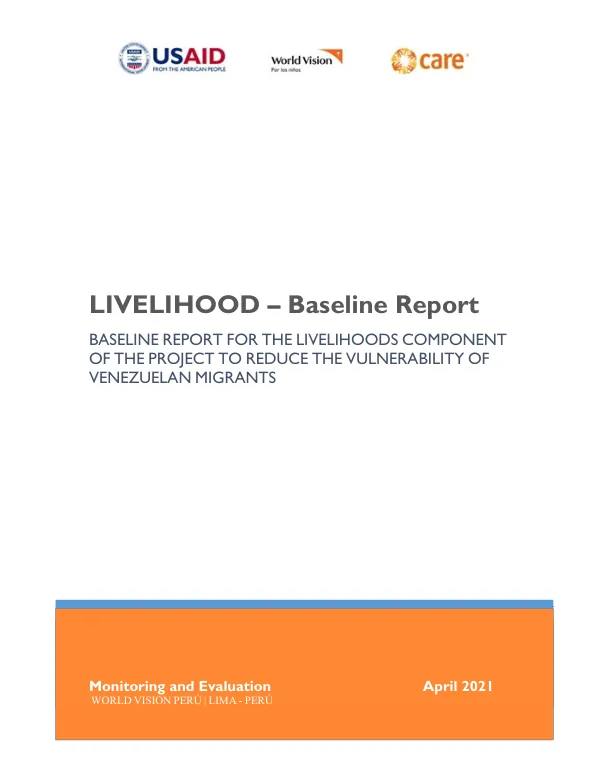
Baseline Livelihood Component. MEAL – OFDA II. Project 2020-2021: Baseline Livelihoods (first cohort - promotion) in Q2
Sign inUSAID DEC
Baseline Livelihood Component. MEAL – OFDA II. Project 2020-2021: Baseline Livelihoods (first cohort - promotion) in Q2
The livelihood component of the project to reduce the vulnerability of Venezuelan migrants aims to provide access to sustainable livelihoods for migrants and refugees in Lima and La Libertad.
2021 · 56 pages
Sign in to readA free account is required to download.
Abstract
The component targets 1,173 participants, with at least 50% women and 10% Peruvian nationality, who have been identified through participation in hot meal and cash transfer programs. The objective of the livelihood component is to provide training and opportunities for self-employment, enabling participants to improve their net income from their businesses. The baseline study was conducted in November 2020, February, and March 2021 to gather information on the initial state of the living conditions for entrepreneurship among the participants. The study aimed to identify the migratory status and vulnerability characteristics of the Venezuelan participants, their educational profile, previous studies, and entrepreneurial skills, as well as their experience and practical skills in entrepreneurship. The study also sought to profile the employment situation of the participants and identify the status of net income from their entrepreneurships. The baseline study was divided into four phases: design and organization, validation process of the instruments, data collection, and data analysis. The study collected information on various indicators, including official identification of the direct participant, immigration status, legal situation, economic interdependence, characteristics of the family members with the greatest vulnerability, characteristics of the participant's home, and access to basic services and communications. The study also collected information on the participant's educational instruction, work characteristics, technical skills or trade, entrepreneurship experience in Venezuela, experience and characteristics of the participant's business in Peru, and identification of participant improvement projections for their business. The population of the study consisted of 1,173 participants, with 90% of Venezuelan nationality and 10% of Peruvian nationality, divided into two promotions. The study used a combination of quantitative and qualitative methods to collect data, including surveys, interviews, and focus groups. The data was analyzed using statistical software to identify trends and patterns in the data. The results of the baseline study will provide valuable information on the living conditions, immigration status, experience in entrepreneurship, employment status, and net income from business of the participants. This information will help decision-makers develop their lines of action and measure progress on the implementation of the project. The study will also inform the development of the livelihood component and provide a baseline for future evaluations. The baseline study identified that the majority of the participants were Venezuelan migrants, with 90% of the population having Venezuelan nationality. The study also found that the participants had limited access to basic services, including healthcare, education, and sanitation. The study identified that the participants had limited experience in entrepreneurship, with many having no prior experience in starting or running a business. The study also found that the participants had limited access to financial resources, with many relying on cash transfer programs to meet their basic needs. The study recommended that the livelihood component focus on providing training and opportunities for self-employment, particularly in areas such as entrepreneurship, financial literacy, and business management. The study also recommended that the component provide access to financial resources, including microloans and savings programs, to enable participants to start and grow their businesses. The study further recommended that the component focus on building the capacity of the participants, particularly in areas such as leadership, communication, and problem-solving.