USAID. MISSION TO JAMAICA
Basic skills training project
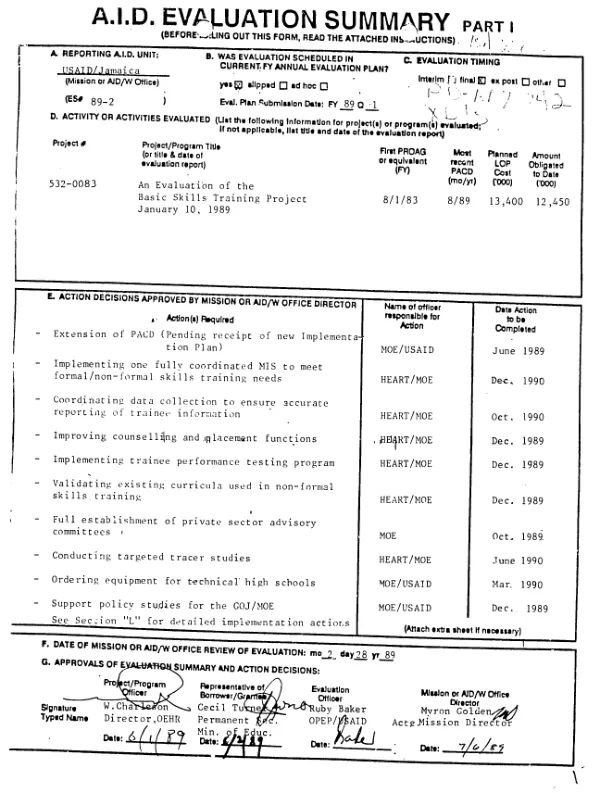
Summarizes final external evaluation (PD-AAZ-256) of a project to help the Government of Jamaica (GOJ) to establish an improved skill training system.
1989
Sign in to readA free account is required to download.
Abstract
Major findings and conclusions were: the project supported a supply-side approach to human resource development, and private sector input was limited to advisory committees or boards; project inputs were skewed in favor of support for operational activities in the H.E.A.R.T. Trust; the original design was based on some questionable assumptions or expectations; the importance attached to the role of coordination as opposed to, say, instructors" salaries, was debatable; it was unrealistic to believe that an oversight coordinative authority could be imposed on the existing bureaucracy; insufficient consideration may have been given to the difficulty of trying to implement a project of this complexity within a 5-year period. The project design failed to anticipate a number of implementation problems and therefore attempted too much too soon. Future projects of this nature should be introduced with a phased, experimental approach and greater consideration of the absorptive capacity of participating agencies; a large knowledge-development component including controlled experimentation; increased involvement of the private sector; separate project funding for participating agencies; and greater use of subcontracting among public agencies. It was recommended that no substantive changes be made to the project, but the PACD be extended to enable completion of certain critical project activities. (Author abstract)