MERCY CORPS INTERNATIONAL
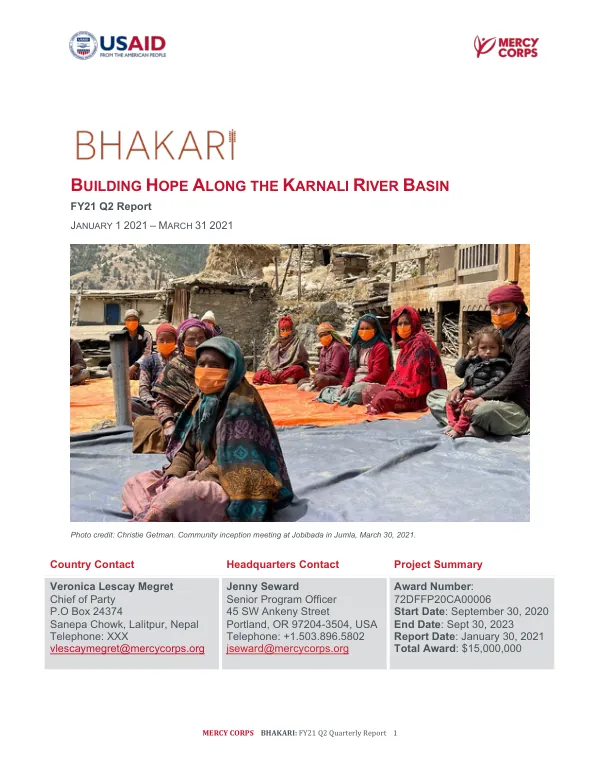
BHAKARI: FY21 Q2 Quarterly Report
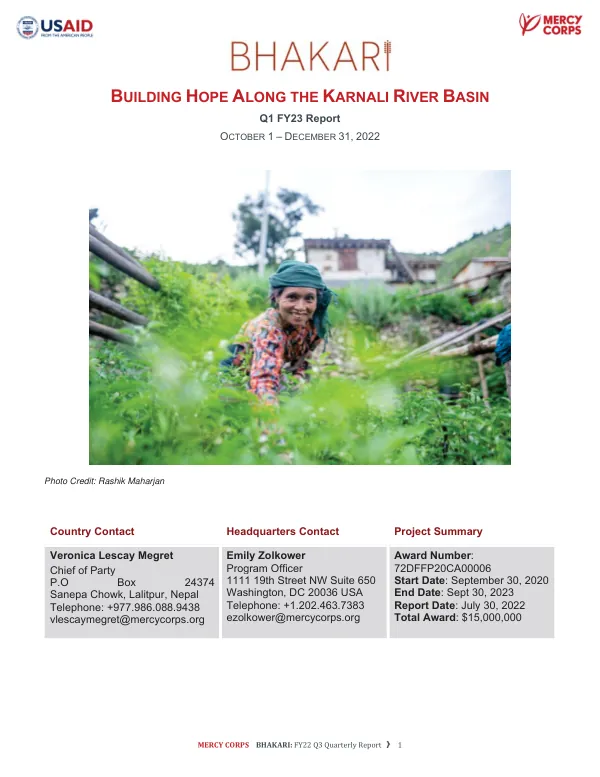
The Karnali River Basin in Nepal is the focus of the BHAKARI project, a USAID-funded initiative implemented by Mercy Corps.
2021 · 10 pages
Sign in to readA free account is required to download.
Abstract
The project aims to improve the livelihoods of rural communities in the region through a range of interventions. The project's agriculture strategy was revamped in the second quarter of FY21, with a focus on sustainable agriculture practices and market access. Orientation sessions were conducted for district implementing partners, and data was collected for a rapid market assessment to identify input suppliers and demand for inputs. A total of 130 farmers' groups were formed or activated, with 61.3% of members being women and 31% from Dalit and Janajatis castes. The agriculture team collaborated with local governments on campaigns promoting organic agriculture and animal health, and supported organized fairs to promote the project's activities. Rapid assessments were conducted to understand the capacity of local input suppliers for the enrollment of the input voucher intervention. The project also focused on increasing the availability of reliable water resources. A five-day capacity building training was completed for district sub-engineers, focusing on practical knowledge of surveying, designing, and implementing productive water projects. Following community prioritization, sub-engineers were mobilized in the field for the feasibility study process. To date, the project has leveraged a total of 5,400,000 Nepalese Rupees (~$45,000 USD) in match funding from local governments across four districts for productive water construction projects. In addition to these interventions, the project aimed to reduce the impacts of natural disasters. A total of 252 Integrated Community Action Plans (ICAPs) were prepared following the integrated community risk assessment process. Local Disaster Management Committees (LDMCs) have been formed/identified in all the working palikas, and community-level Disaster Management Committees (CDMCs) and Task Force teams were formed in all 252 communities to enhance their capacity and train them as first responders to respond to emergencies. The project also engaged in regular coordination and collaboration with provincial, district, and municipal authorities to ensure effective implementation of the project's activities. The project's progress was monitored through regular reporting and evaluation, with a focus on achieving the project's objectives and outcomes. The project's activities were designed to be sustainable and scalable, with a focus on building the capacity of local communities and institutions to manage and maintain the project's interventions over the long term. The project's cash transfer programming mechanism was established through the development of Standard Operating Procedures (SOPs), which were contextualized based on research on existing cash transfer regulations and scoping of transfer service providers. Contracting for Transfer Service Providers was initiated, with the goal of establishing a robust and efficient cash transfer system that can reach program participants in a timely and effective manner. The project's Community Accountability and Reporting Mechanism (CARM) assessment was completed to assess the current practices and policies of implementing partners, and to identify areas for improvement. CARM flyers were developed and distributed in target communities to sensitize program participants on feedback channels and complaint mechanisms. The project's water for productive use team completed orientation activities with district teams and capacity building training to technical teams, focusing on community prioritization guidelines, framework preparation, and leveraging government funds for match funding. To date, the project has leveraged a total of 5,400,000 Nepalese Rupees (~$45,000 USD) in match funding from local governments across four districts for productive water construction projects. A GESI First Approach training was organized for 45 staff, focusing on the importance of GESI and ways to integrate GESI while formulating activity plans and its implementation. NTAG, the project's technical partner, prepared its GESI policy after the training. The project's SBC key messages on COVID-19, nutrition, GESI, and DRR were disseminated through the 321 platform, a message dissemination platform of Nepal Telecoms. The messages were shared with impact groups during household registration to maximize listenership.
Related documents