MERCY CORPS INTERNATIONAL
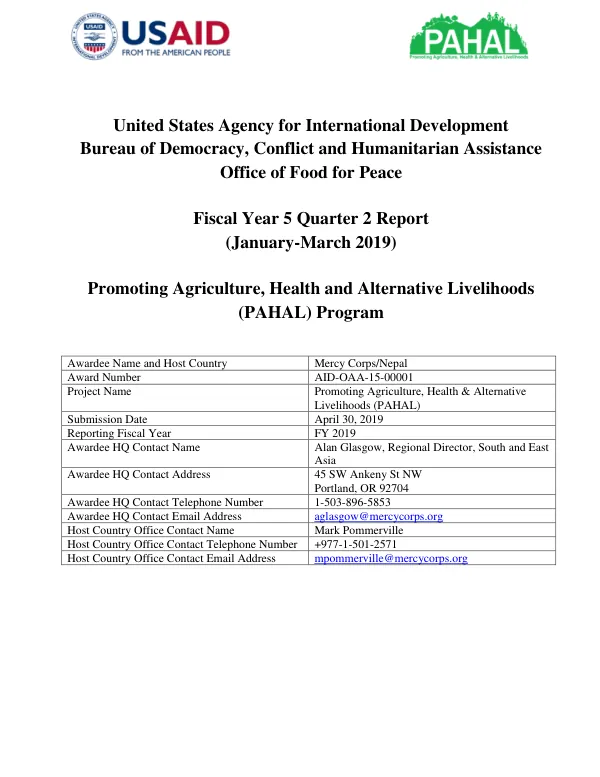
Fiscal Year 5 Quarter 2 Report (January-March 2019)
The Promoting Agriculture, Health and Alternative Livelihoods (PAHAL) program is a $25 million, five-year initiative designed to achieve food security among vulnerable populations in 14 districts in the middle and high hills of Far-West and Mid-West Nepal.
2019 · 20 pages
Sign in to readA free account is required to download.
Abstract
The program is a Development Food Assistance Project under the Bureau for Democracy, Conflict and Humanitarian Assistance/Office of Food for Peace that takes a multi-dimensional, systems approach to address the underlying socio-political, economic and ecological constraints, and the related shock and stress exposures, that drive food insecurity in Nepal. PAHAL's sub-purposes form the resilience pathways, which will enable people of vulnerable communities to better cope with and absorb shocks and stresses, adapt to better health and livelihood strategies in order to effectively reduce exposure to and impact of shocks and stresses, and recover quickly and 'bounce back better' through transformed systems in the face of shocks and stresses. The program's systems approach strategically links sub-intermediate outcomes and key results under coordinated work plans, classifying its intermediate outcomes under key systems as follows: Ecological, Economic, Social, and Transformative. During the second quarter of FY19, PAHAL continued to implement its interventions in 46 Rural/Municipalities throughout the program's 14 targeted districts. The program conducted interventions directly improving the sustainability of community groups, including improved planning and governance centered around ensuring the knowledge, resources, and motivation remains intact after program closeout. PAHAL's interventions directly benefited 36,972 unique beneficiaries during this reporting period. The total number of people who participated in project activities is presented by sector in Table 2. The number of people reached by system and system combinations is shown in Table 3. The Ecological System, within the confines of this program, encompasses several components of Nepal's ecology: water, land, forests, and human beings. The program aims to achieve three major results that map to the sub IOs/or sub-systems: women, men, and community groups applying DRR measures and climate information to prepare for, and respond to, ecological shocks and make on and off farm investments that will ultimately enhance their resilience towards coping with future events. Marginalized community members access quality water services, despite unanticipated water-related shocks and stresses. Women and men manage productive natural resources and natural resource management systems, contributing to PAHAL's stipulated goal and objectives. The program's resilience integration approach highlights the different community group linkages within the program's integrated work plan, ensuring that groups are achieving high-level food security and resilience results. PAHAL's interventions in the Ecological System include improved access to effective disaster risk management services, strategies, and technologies, as well as better access to improved water technologies. The program also focuses on improved access to productive natural resources and resource management systems, which contributes to the overall goal of achieving food security among vulnerable populations in Nepal.