MERCY CORPS INTERNATIONAL
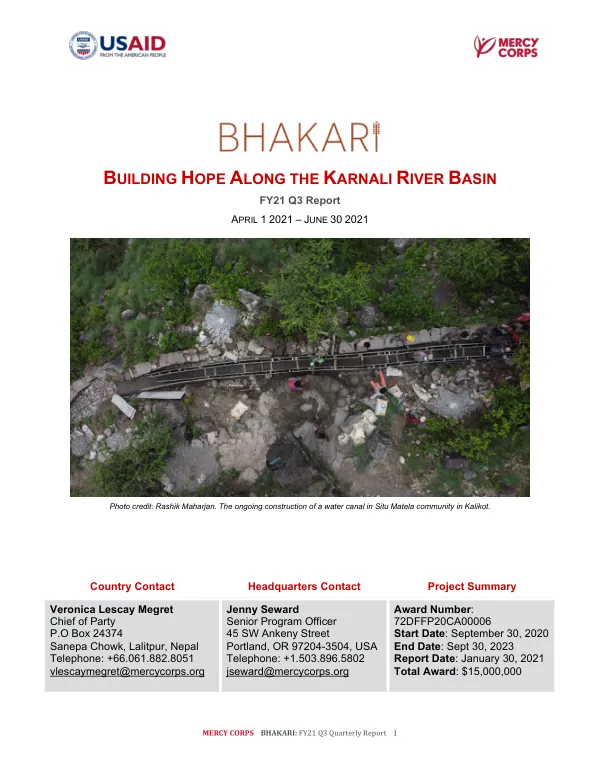
BHAKARI: FY21 Q3 Quarterly Report
The agricultural development initiative in Nepal's Karnali River Basin, led by Mercy Corps, began in September 2020 with funding from USAID's Food Security Program.
2021 · 10 pages
Sign in to readA free account is required to download.
Abstract
The project aimed to address drought and COVID-19-related challenges in the region. Initial assessments identified soil degradation, limited market access, and reduced crop yields as primary concerns. Implementation focused on three key interventions: Cash for Work (CfW), Unconditional Cash Transfers (UCT), and Essential Complementary Activities. The CfW program, launched in June 2021, involved 1,029 households in drought-affected areas. UCT was provided to 58 labor-poor households in Surkhet district. Essential Complementary Activities included agriculture input voucher packages, animal health checks, and farmer group capacity building. A COVID-19 impact assessment was conducted among 395 registered households in six districts, revealing significant socio-economic impacts, including food insecurity, loss of livelihoods, and reduced access to markets. The assessment highlighted the need for emergency response to address the triple threats of winter drought, COVID-19, and the monsoon. BHAKARI reached 10,539 unique individuals in Q3, including those participating in Integrated Community Assessment Action Planning, recipients of UCT, and community sensitization for cash-based response interventions. The project also collaborated with local government and development partners to address Fall ArmyWorm and implement Integrated Pest Management (IPM) training. Agriculture input voucher packages were finalized in coordination with farmers, input supply vendors, and government stakeholders. Two different packages were developed based on geographical terrain. Animal health checks were conducted on 1,397 livestock, and 55 farmer groups were formed and provided orientation on their roles and responsibilities. The orientation highlighted the importance of Gender Equality, Social Inclusion (GESI), governance, and accountability. Coordination meetings were held with palika and district agriculture departments to understand the damage caused by Fall ArmyWorm and management initiatives of the local government. A three-day IPM training was completed, with 28 participants from BHAKARI's cluster teams and partner staff. The training focused on using organic local fertilizer and pesticides using local materials. A separate session was facilitated by the District Agriculture Officer on the importance of organic agriculture. A two-day training on nutrition was led by NTAG, with a focus on breastfeeding and the First 1,000 days. The training provided nutrition messages as cross-cutting themes in different thematic areas. A guideline on permagarden/kitchen garden training integrating a nutritional component for smallholder farmers was drafted. BHAKARI also coordinated with the Karnali provincial government and was assigned as a member of the Provincial Food Security Cluster during emergencies. The project's efforts were highly appreciated by the Project Advisory Committee (PAC) members and mayors from Dailekh and Surkhet, who participated in the virtual meeting. District Inception meetings were conducted in four districts, where the team presented program goals, objectives, and priority areas and discussed opportunities for collaboration and resource leveraging amongst stakeholders.
Related documents