USAID DEC
Bi Weekly Summary Report: Construction Management of the Jordan School Expansion Project (JSEP) and the Schools for a Knowledge Economy Project (SKEP)
Sign inMOE
Bi Weekly Summary Report: Construction Management of the Jordan School Expansion Project (JSEP) and the Schools for a Knowledge Economy Project (SKEP)
The Jordan School Expansion Project (JSEP) and the Schools for a Knowledge Economy Project (SKEP) are ongoing initiatives aimed at expanding and upgrading schools in Jordan.
2019 · 14 pages
Sign in to readA free account is required to download.
Abstract
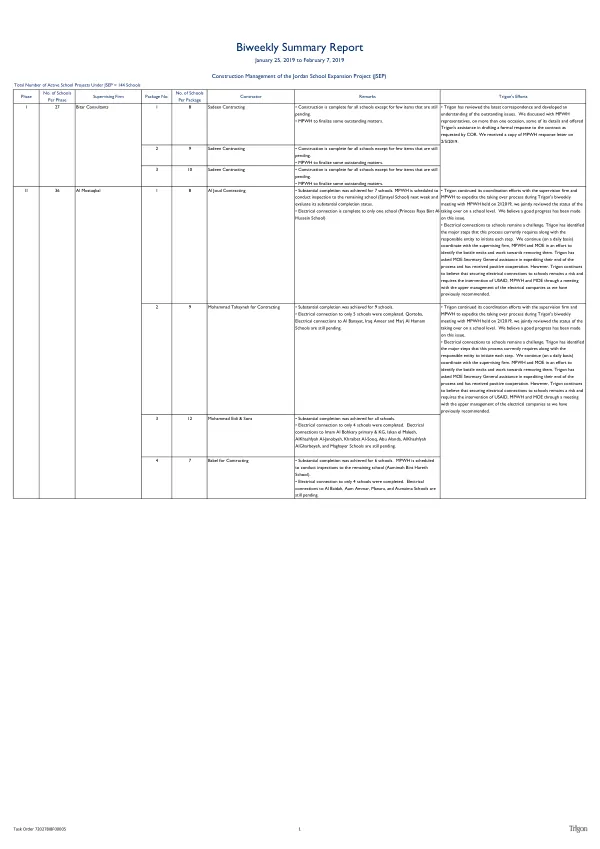
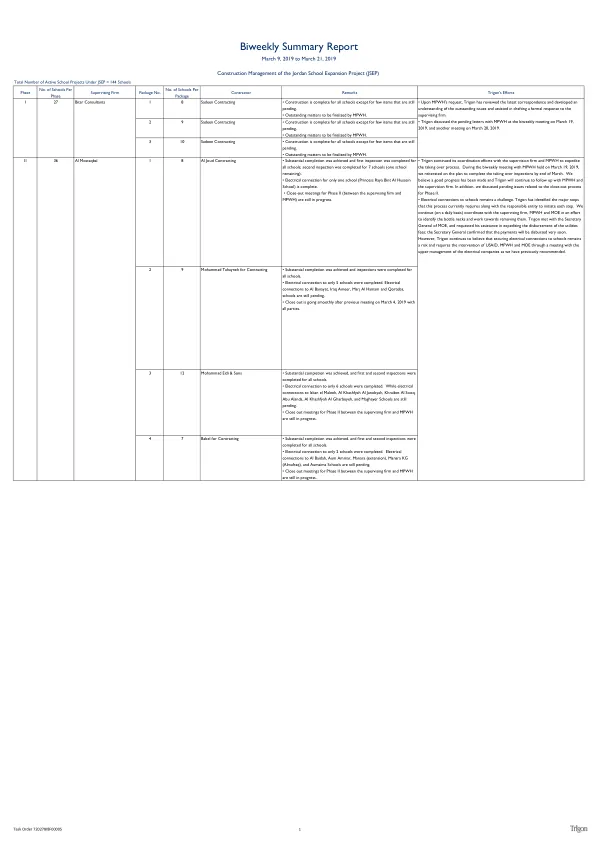
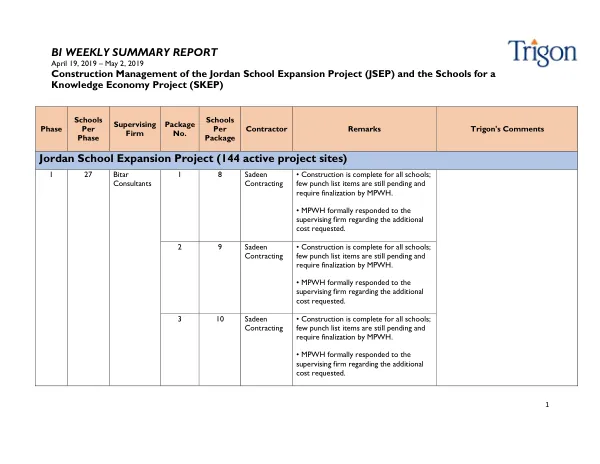
The projects are being managed by Trigon, with the support of USAID and the Ministry of Public Works and Housing (MPWH). The construction management of the projects involves multiple phases, with each phase consisting of several packages. Phase I of the JSEP consists of 27 schools, with 8 schools per package. The supervising firm for Package 1 is Bitar Consultants, with Sadeen Contracting as the contractor. Construction is complete for all schools in this package, with few punch list items still pending. The MPWH has formally responded to the supervising firm regarding the additional cost requested. Phase II of the JSEP consists of 36 schools, with 8 schools per package. The supervising firm for Package 1 is Al Mostaqbal, with Al Joud Contracting as the contractor. Utilities remain a major challenge in this package, with only one school completed and 7 schools still pending. Trigon has continued to follow up with MPWH and the supervising firm to expedite the taking over process. The Schools for a Knowledge Economy Project (SKEP) consists of 48 schools, with 11 schools per package. The supervising firm for Package 1 is Waheeb Mednant, with Samara & Yousef Contracting as the contractor. All HP Cameras and HP Printers have been delivered to the sites, and USAID has paid the second mobilization payment submitted in March 2019. Throughout the projects, Trigon has raised concerns about the utilities issue, which remains a major challenge. Trigon has provided suggestions to MPWH to improve the utilities follow-up process at the ministry and has offered their services to assist the ministry by following up with the Ministry of Education (MOE). However, Trigon continues to believe that securing electrical connections to schools remains a risk and requires the intervention of USAID, MPWH, and MOE through a meeting with the upper management of the electrical companies. The percentage of school completion ranges between 3% and 77% across the different packages. Trigon has held meetings with the supervising firms to discuss major issues and has agreed to meet on a monthly basis to discuss the progress of the project and required actions.