USAID DEC
Bilateral Workshop for Improved Co-Management of Artisanal Fisheries in The Gambia and Senegal
Sign inCOASTAL RESOURCES CENTER OF THE UNIVERSITY OF RHODE ISLAND
Bilateral Workshop for Improved Co-Management of Artisanal Fisheries in The Gambia and Senegal
The Gambia-Senegal Sustainable Fisheries Project, a collaborative initiative between the two countries, aimed to promote cooperative arrangements for fisheries science, technology, and management.
2012 · 32 pages
Sign in to readA free account is required to download.
Abstract
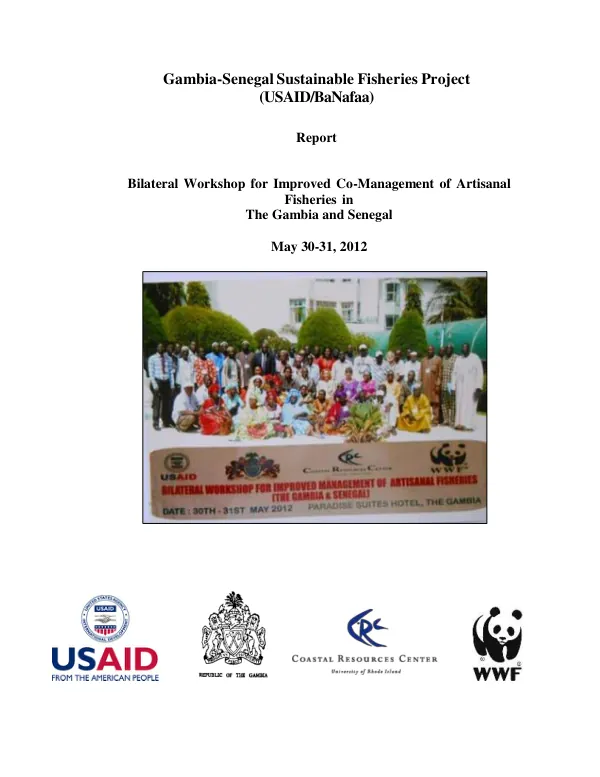
The project was supported by the United States Agency for International Development (USAID) through the Ba Nafaa project. The project's objective was to initiate discussion about the fisheries issues of importance to Senegal and The Gambia, with a focus on promoting sustainable fisheries management and improving livelihoods. A bilateral workshop was convened on May 30-31, 2012, bringing together over 80 stakeholders, including artisanal fishermen, women, fish mongers/dealers, fisheries non-governmental organizations, and government officials. The workshop featured presentations and plenary discussions on key topics, including lessons learned in co-management of artisanal fisheries, organizational structures and functioning of community-based fisheries management organizations, and balancing sustainability and open access. The presentations drew from the experiences of Local Artisanal Fisheries Committees (CLPA) in Senegal and the National Sole Co-Management Committee (NASCOM) in The Gambia. Stakeholders were engaged actively through work groups on four themes: constraints and opportunities for co-management of artisanal fisheries, management measures for artisanal fisheries, roles and responsibilities of community-based organizations, and open access. The workshop's final recommendations and action plan included the establishment of an ad hoc bilateral committee, convening a bilateral workshop once a year, and combating illegal, unreported, and unregulated (IUU) fishing. The project's geographic focus was on the West African Marine Ecoregion (WAMER), which spans 3,500 km of coast in western Africa. The region's coastal upwelling creates a productive food chain supporting incredible biodiversity, making it one of the most diverse and economically important fishing zones in the world. The project's timeframes were not explicitly stated, but the workshop's recommendations and action plan were to be implemented by October 2012. The Gambia-Senegal Sustainable Fisheries Project aimed to address the challenges of open access, IUU fishing, and overexploitation of resources in the region. The project's recommendations included establishing area and seasonal closures, marine protected areas (MPAs), and free trade zones in fish and fish products. The project's implementation details were not provided, but the recommendations and action plan outlined a framework for collaborative management and sustainable fisheries development in the region.