COASTAL RESOURCES CENTER
Participatory Rural Appraisal (PRA) Report: Cockle Harvesting Activity
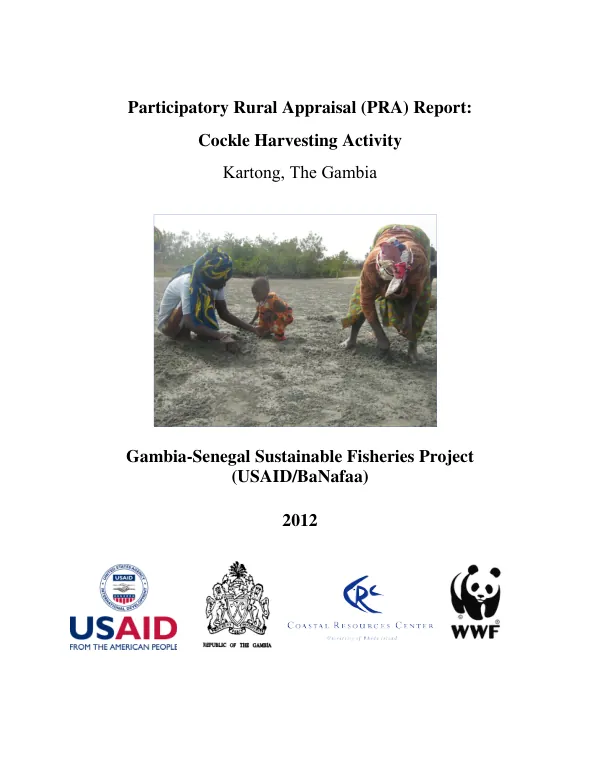
The Gambia-Senegal Sustainable Fisheries Project, implemented by the USAID/BaNafaa project, conducted a Participatory Rural Appraisal (PRA) report to collect local knowledge and information on the cockle harvesting activity in Kartong, The Gambia.
2012 · 19 pages
Sign in to readA free account is required to download.
Abstract
The study aimed to determine the feasibility of transplanting cockles from high-density areas to lower-density areas in the Allahein River and its tributaries. The PRA was conducted on May 8-9, 2012, and involved about 20 women-cockle harvesters and TRY members. The women were divided into two groups, and both groups answered the same questions and filled the same tables. The gathered information will be used to develop the Co-Management Plan for Cockle Fishery for Allahein River, Kartong. The cockle collection sites were identified and mapped by TRY members, and the harvesting areas were also mapped using a GPS unit. The women complained that the population of cockles has decreased significantly in recent years. The cockle harvesting sites were listed in Table 1, and the community map was developed during the meeting. The TRY Kartong group has 40 registered members who are engaged in both oyster and cockle harvesting. The women have been doing this work for most of their lives and are organized and know each other well. The cockle harvesting and processing to obtain the end product is done in two days, and on the third day, the women travel to the local markets to sell cockle meat. The chain of activities of cockle collection is summarized below. On the first day, the women walk to the beach side, travel to the harvesting site, and harvest cockles. The harvesting is done during low tide, and the women usually go together to the site, spread throughout it, and collect the cockles into their own rice bags. If there are plenty of cockles, it takes about 30 minutes to fill one bag, and if there are few cockles to harvest, it can take up to 4-6 days. The women complained that the population of cockles has decreased significantly in recent years, and they face several challenges, including the lack of resources and equipment. The women also mentioned that they have to travel long distances to reach the harvesting sites, and they have to deal with the high tide, which makes it difficult to access the sites. The PRA report highlights the importance of involving local communities in the management of fishery resources. The participation of the community in collecting basic information on cockle harvesting and processing activities is critical, especially in data-deficient situations. The report also emphasizes the need for the development of a Co-Management Plan for Cockle Fishery for Allahein River, Kartong, which will involve the participation of local communities and other stakeholders. The report concludes that the cockle harvesting activity is an important source of income for the women in Kartong, and it is essential to develop a plan to manage the cockle fishery resources sustainably. The plan should involve the participation of local communities, and it should address the challenges faced by the women, including the lack of resources and equipment, and the high tide, which makes it difficult to access the harvesting sites. The report recommends that the USAID/BaNafaa project should continue to support the development of the Co-Management Plan for Cockle Fishery for Allahein River, Kartong, and that the project should work closely with local communities and other stakeholders to ensure the success of the plan. The report also recommends that the project should provide training and capacity-building programs for the women to improve their skills and knowledge in cockle harvesting and processing. The report highlights the importance of involving local communities in the management of fishery resources and emphasizes the need for the development of a Co-Management Plan for Cockle Fishery for Allahein River, Kartong. The report concludes that the cockle harvesting activity is an important source of income for the women in Kartong, and it is essential to develop a plan to manage the cockle fishery resources sustainably.