COASTAL RESOURCES CENTER OF THE UNIVERSITY OF RHODE ISLAND
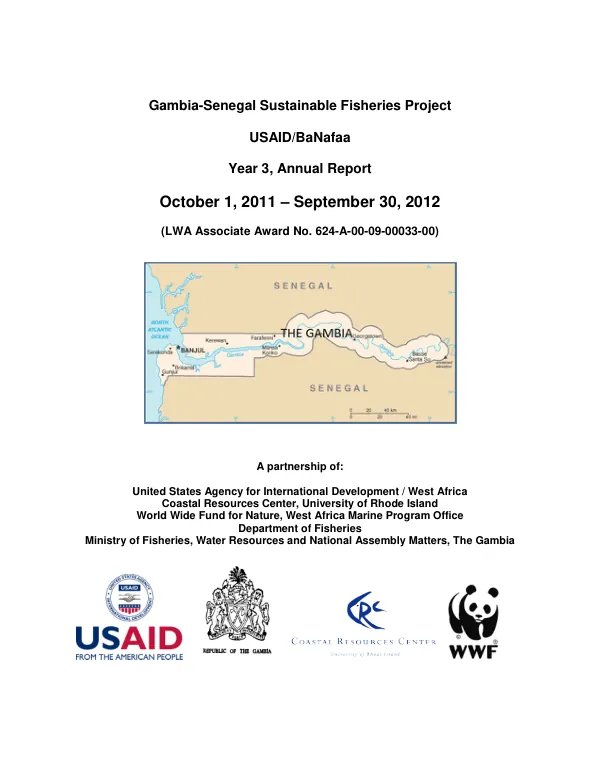
Gambia-Senegal Sustainable Fisheries Project Year 3 Annual Report
The Gambia-Senegal Sustainable Fisheries Project is a five-year regional initiative supported by the American people through the U.S.
2012 · 89 pages
Sign in to readA free account is required to download.
Abstract
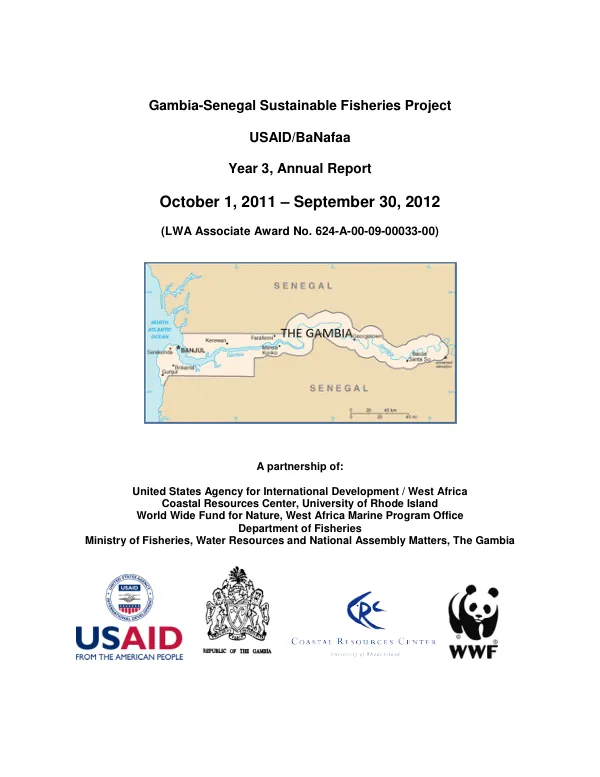
Agency for International Development (USAID)/West Africa Regional Mission. The project is implemented through the University of Rhode Island (URI)-USAID cooperative agreement on Sustainable Coastal Communities and Ecosystems (SUCCESS). The World Wide Fund for Nature West Africa Marine Program Office (WWF-WAMPO) is a regional implementing partner. The project's primary goal is to promote sustainable fisheries management in The Gambia and Senegal. To achieve this objective, the project focuses on three key areas: effective co-management of fisheries, strengthened capacity of local organizations, and improved governance and sustainability. The project's approach involves working with local stakeholders, including fishermen, women's associations, and government agencies, to develop and implement co-management plans for the sole fishery and oyster and cockle fisheries. In Year 3, the project made significant progress in achieving its objectives. The project's efforts to develop effective co-management plans for the sole fishery and oyster and cockle fisheries resulted in the establishment of a sole fishery co-management plan and an oyster and cockle co-management plan. These plans were developed through a participatory process involving local stakeholders and are designed to promote sustainable fisheries management and improve the livelihoods of fishermen and their families. The project also strengthened the capacity of local organizations, including the TRY Oyster Women's Association, the National Sole Co-Management Committee (NASCOM), and the Association of Gambian Fishing Companies (TAGFC). These organizations played a key role in the development and implementation of the co-management plans and are now better equipped to manage the fisheries sustainably. In addition to its work on co-management and capacity building, the project also made progress in improving governance and sustainability. The project's efforts to promote good governance and sustainability included the development of governance scorecards and the implementation of a comparative cost study on sole fish in The Gambia and Senegal. These initiatives are designed to promote transparency and accountability in the management of the fisheries and to ensure that the benefits of the fisheries are shared equitably among all stakeholders. The project's work on water, sanitation, and hygiene (WASH) and climate change vulnerability assessment also made significant progress in Year 3. The project's efforts to improve WASH in the fisheries sector included the development of a WASH plan and the implementation of a needs assessment site mapping exercise. The project's work on climate change vulnerability assessment involved the development of a climate change vulnerability assessment framework and the implementation of a bi-lateral climate change vulnerability assessment in The Gambia and Senegal. Overall, the Gambia-Senegal Sustainable Fisheries Project made significant progress in Year 3 towards achieving its objectives of promoting sustainable fisheries management in The Gambia and Senegal. The project's efforts to develop effective co-management plans, strengthen the capacity of local organizations, and improve governance and sustainability have laid the foundation for a more sustainable and equitable fisheries sector in the region.