USAID DEC
Biodiversity of Soil Macrofauna in Jelutong (Dyera lowii Hook.F) based Agroforestry System on Peatlands
Sign inUSAID DEC
Biodiversity of Soil Macrofauna in Jelutong (Dyera lowii Hook.F) based Agroforestry System on Peatlands
Peatlands are a unique ecosystem with an unparalleled diversity of flora and fauna.
2021 · 8 pages
Sign in to readA free account is required to download.
Abstract
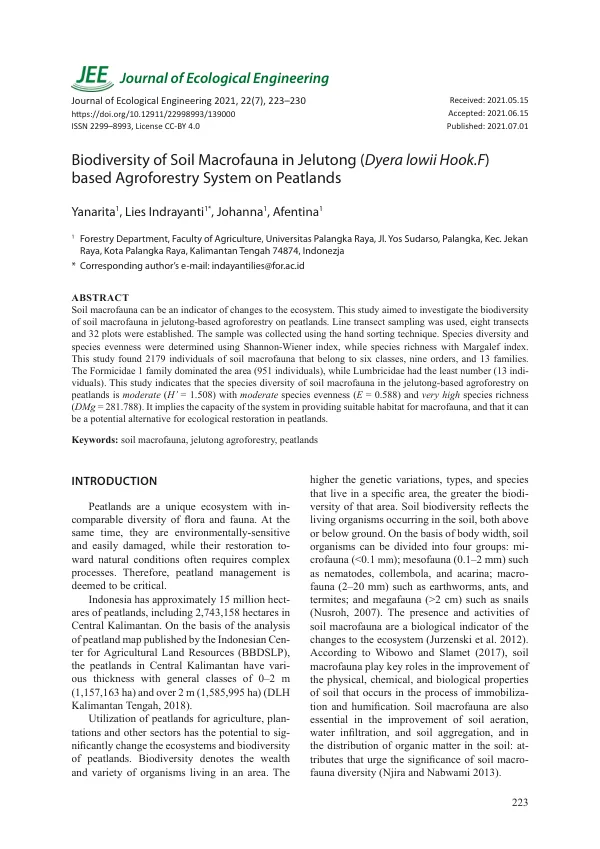
They are environmentally sensitive and easily damaged, and their restoration towards natural conditions often requires complex processes. Therefore, peatland management is deemed critical. Indonesia has approximately 15 million hectares of peatlands, including 2,743,158 hectares in Central Kalimantan. The peatlands in Central Kalimantan have various thickness, with general classes of 0–2 m (1,157,163 ha) and over 2 m (1,585,995 ha). The utilization of peatlands for agriculture, plantations, and other sectors has the potential to significantly change the ecosystems and biodiversity of peatlands. Biodiversity denotes the wealth and variety of organisms living in an area. The higher the genetic variations, types, and species that live in a specific area, the greater the biodiversity of that area. Soil biodiversity reflects the living organisms occurring in the soil, both above or below ground. Soil organisms can be divided into four groups: microfauna (<0.1 mm), mesofauna (0.1–2 mm), macrofauna (2–20 mm), and megafauna (>2 cm). The presence and activities of soil macrofauna can support the agroforestry system and serve as an indicator of soil fertility on peatlands. The abundance of macrofauna populations indicates the plants growing in these areas tend to produce a lot of litter, which eventually contributes to the availability of organic matter as it will be decomposed by fungi, bacteria, and actinomycetes into essential nutrients for plants. The number and type of stands will affect the biodiversity of local macrofauna. One of the land use patterns in Kalampangan is agroforestry, which is the combination of annual crops or perennial plants (i.e., jelutong) with seasonal or agricultural crops. The study aimed to investigate the biodiversity of soil macrofauna in jelutong-based agroforestry on peatlands. The research site was located in the Kalampangan village, Palangka Raya City, Central Kalimantan, Indonesia. The study area was 1 ha, which is inundated in the rainy season, particularly during very heavy rainfall. However, the establishment of recent tertiary channels and trenches have reduced the period of inundation into 1–7 days. The study was conducted in September-October 2020. The primary data included macrofauna collected from the research site. The equipment consisted of gloves, sacks, hoes, tape measure/ruler, raffia rope, tweezers, 12 x 20 cm clear plastic bags, shovels, machetes, sieves, tarpaulin, label paper, stationery, magnifying glass, camera, and 70% alcohol (to preserve specimens). The study found 2179 individuals of soil macrofauna that belong to six classes, nine orders, and 13 families. The Formicidae 1 family dominated the area (951 individuals), while Lumbricidae had the least number (13 individuals). The study indicates that the species diversity of soil macrofauna in the jelutong-based agroforestry on peatlands is moderate (H' = 1.508) with moderate species evenness (E = 0.588) and very high species richness (DMg = 281.788). It implies the capacity of the system in providing suitable habitat for macrofauna, and that it can be a potential alternative for ecological restoration in peatlands.