USAID. BUR. FOR SCIENCE AND TECHNOLOGY. OFC. OF AGRICULTURE
Biotechnology plant tissue culture
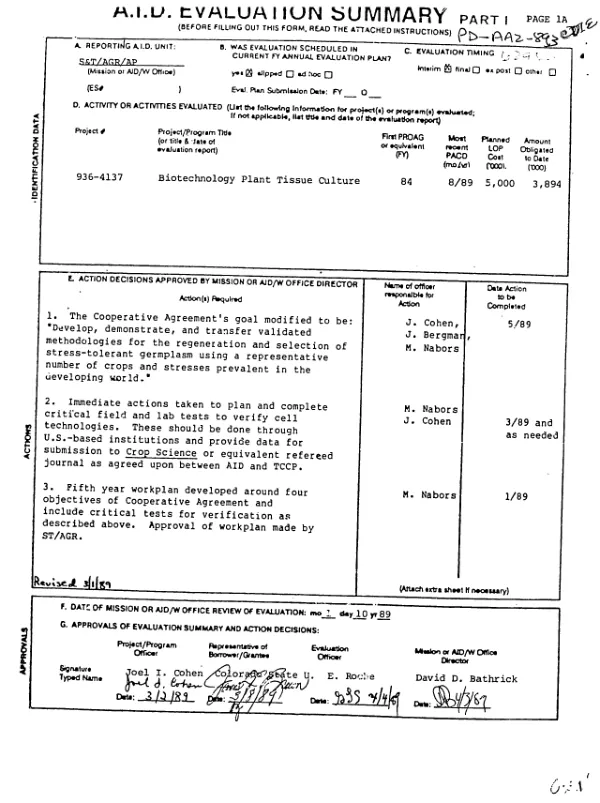
Summarizes midterm evaluation (XD-AAZ-893-A)) of a grant to Colorado State University (CSU) to conduct tissue culture research relevant to Third World crop production and to strengthen Third World capacity in this field.
1989
Sign in to readA free account is required to download.
Abstract
Several problems have hindered project effectiveness, with miscommunication between CSU and A.I.D. being the most important. There has been confusion as to the purpose of the project, the research hypothesis to be tested, and the methodology to be employed in validating it. This has contributed in turn to some of the project"s management problems -- e.g., late reporting, short-term focus on level of effort, ineffective use of outside expertise, insufficient emphasis on outputs, and lack of sufficient information on the cost of producing outputs. Research progress has been mixed. While CSU has performed well in obtaining information on cell culture, stress tolerance selection, and plant regeneration in vitro for cereals and grain legumes, verification of stress tolerance under field conditions has been noticeably slow and disappointing. As a result, field testing will not be completed by the end of the project without terminating most of the in vitro activities. These problems were predictable, given the lack of plant breeding, agronomic, and statistical expertise within the project. Researchers have not understood the significance of field verification tests nor the importance of statistical control and inferences in summarizing data; have conducted field evaluations on an ad hoc basis; and have not decided whether the purpose of the project is the development of "methodology" or "germplasm." The project has made remarkable progress in training and in networking. However, it has had difficulty in working with institutions having expertise in stress tolerance phenomena at the cellular level. Two major lessons have been learned. (1) Plant biotechnology projects must integrate conventional and new technologies, and to do this more than one institution should be involved in a project of this type. (2) Consideration of crop modification technologies should be demand-driven and private sector-oriented, and have provisions for market and economic analysis and for rights for first refusal regarding the development of proprietary technology or germplasm. Key action decisions are to clarify the project purpose, focus on a limited number of crops and stresses, and cut back on in vitro activities.