USAID. BUR. FOR SCIENCE AND TECHNOLOGY. OFC. OF AGRICULTURE
Spring x winter wheat
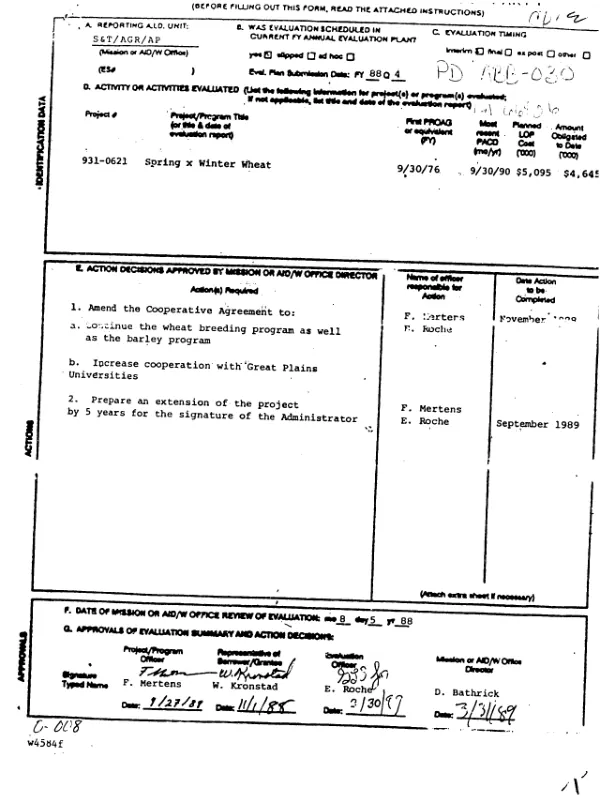
Summarizes interim evaluation (PD-AAY-778) of a project implemented by Oregon State University (OSU) and the International Center for Improvement in Maize and Wheat (CIMMYT) to conduct varietal research on spring and winter wheat and barley germplasm, and to transfer the germplasm and breeding technologies to developing countries.
1989
Sign in to readA free account is required to download.
Abstract
Evaluation covers the period 1/86 to 7/88. With an excellent working relationship between OSU and CIMMYT, progress has been exceptional. Genetic diversity of wheat has been enhanced through the collection and evaluation of over 10,000 cultivars. Advances in winter wheat, however, have been slower than spring wheat due to its vernalization requirement. The barley breeding program is in its initial stages, but has already achieved some very significant results, especially in the development of a doubled haploid technique, which could shorten considerably barley"s breeding cycle. Chile and Turkey have utilized winter habit varieties developed from OSU germplasm, and Argentina, Peru, and Bolivia are very near the release of such varieties. Spring habit varieties have been distributed by national programs in at least 19 developing countries and are estimated to be grown on about 10% of the total wheat area in the Third World. Further, the project"s winter and spring crosses are the source of about 30% of the advanced lines being developed for soft white winter wheat in Oregon and of 60% of CIMMYT"s spring wheat advanced lines. A microcomputer database for cereal breeding research was created by OSU and has been adopted by several developing country institutions. OSU has also assisted in the transfer of CIMMYT/Turkey"s winter wheat database and CIMMYT/Mexico"s field weighing procedure to computer-based systems. Moreover, 15 international graduate students are enrolled at OSU to study cereal sciences. Due to the success of the project, they have been able to secure support from outside sources as well at an average cost to the project of only $4,000 per year. In spite of its success, the project has been adversely affected by a 25% reduction in A.I.D. funds, the uncertainty of future financial support, and the addition of the barley germplasm component without increased funding. While the Oregon Wheat Growers League has partially replaced the budget cutbacks, the evaluation strongly recommends that project funding be extended an additional 5 years to continue the maturation of the winter wheat and barley programs. Two notable lessons were learned. (1) New varieties of spring and winter wheat take at least 10 years to develop, making long- term financing essential to a cereal breeding program. (2) Land grant institutions can encourage domestic support for international programs. See also abstract of PD-AAY-778.
Related documents
![Final report : July 1, 1985 through June 30, 1990 : spring x winter wheat project (DA-0621-A-00-4044-00) [ie, DAN-0621-A-00-4044-00]](https://covers.devme.ai/gen/56979.webp)