USAID DEC
Birth Spacing and Risk of Autism and Other Neurodevelopmental Disabilities: A Systematic Review
Sign inUSAID
Birth Spacing and Risk of Autism and Other Neurodevelopmental Disabilities: A Systematic Review
Birth spacing, defined as the interval between the birth of two consecutive children, has been associated with an increased risk of autism spectrum disorder (ASD) and other neurodevelopmental disabilities.
2016 · 13 pages
Sign in to readA free account is required to download.
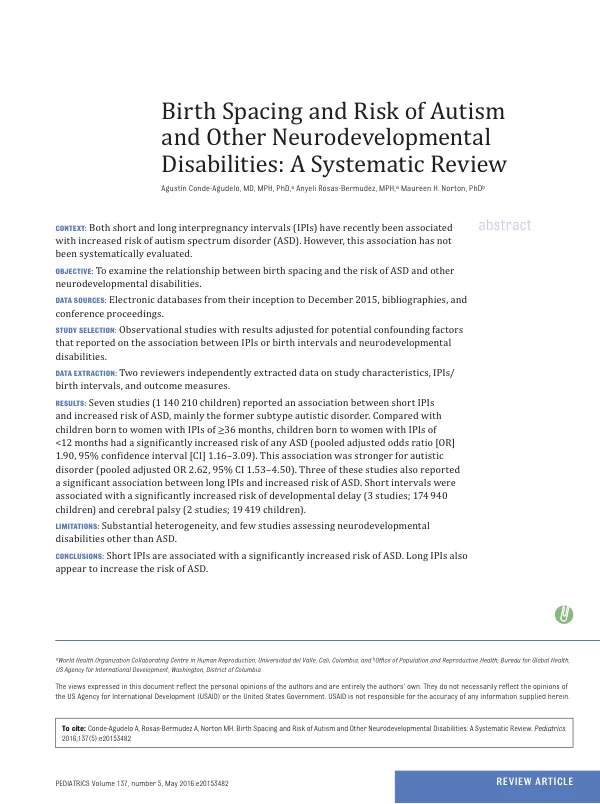
Abstract
A systematic review of observational studies examined the relationship between birth spacing and the risk of ASD and other neurodevelopmental disabilities. The review included 7 studies with a total of 1,140,210 children, which reported an association between short interpregnancy intervals (IPIs) and an increased risk of ASD. Children born to mothers with IPIs of less than 12 months had a significantly increased risk of ASD compared to those born to mothers with IPIs of 36 months or more. The association was stronger for autistic disorder, with a pooled adjusted odds ratio of 2.62 (95% confidence interval 1.53-4.50). Short IPIs were also associated with an increased risk of developmental delay and cerebral palsy. The review also found that long IPIs were associated with an increased risk of ASD, with a pooled adjusted odds ratio of 1.90 (95% confidence interval 1.16-3.19). The relationship between birth spacing and the risk of neurodevelopmental disabilities is complex and influenced by multiple factors, including genetics, environment, and prenatal and perinatal conditions. The review suggests that helping women and couples achieve healthy pregnancy spacing might contribute to reducing the risk of adverse outcomes. The systematic review was conducted following a prospectively prepared protocol and reported in accordance with recommended methods for systematic reviews of observational studies. Two reviewers independently extracted data on study characteristics, IPIs, and outcome measures, and assessed the risk of bias in the studies. The review included studies that met specific criteria, including cohort, cross-sectional, or case-control studies that evaluated the relationship between birth spacing and the risk of any neurodevelopmental disability in the younger child of a pair of siblings. The review found that the association between short IPIs and ASD was stronger for autistic disorder, with a pooled adjusted odds ratio of 2.62 (95% confidence interval 1.53-4.50). The association between short IPIs and developmental delay was also significant, with a pooled adjusted odds ratio of 1.90 (95% confidence interval 1.16-3.19). The review also found that long IPIs were associated with an increased risk of ASD, with a pooled adjusted odds ratio of 1.90 (95% confidence interval 1.16-3.19). The review suggests that the relationship between birth spacing and the risk of neurodevelopmental disabilities is complex and influenced by multiple factors, including genetics, environment, and prenatal and perinatal conditions. The review highlights the need for further research to better understand the relationship between birth spacing and the risk of neurodevelopmental disabilities. Neurodevelopmental disabilities are a diverse group of chronic disorders that begin at any time during the developmental process, including conception, birth, and growth up to 22 years of age, and last throughout an individual's lifetime. The most common disabilities include intellectual disability, learning disabilities, communication disorders, autism spectrum disorder (ASD), and cerebral palsy. In 2007, it was estimated that over 200 million children under the age of 5 in developing countries suffer from some kind of developmental delay or disability. In the United States, neurodevelopmental disabilities affect 15% of children aged 3 to 17 years, or nearly 10 million children, and 1 in 68 children has been identified with ASD. Most neurodevelopmental disabilities are thought to be caused by a complex mix of factors, including genetics, environment, parental health and behaviors during pregnancy, complications during birth, and perinatal infections. Recent findings suggest an early origin of some neurodevelopmental disorders, such as ASD, and several studies have found associations between prenatal and perinatal conditions and the risk of ASD, attention-def