USAID
Comparative Analysis of Kentucky and Colombia
Kentucky and Colombia share a common history of turmoil before achieving statehood and independence.
4 pages
Sign in to readA free account is required to download.
Abstract
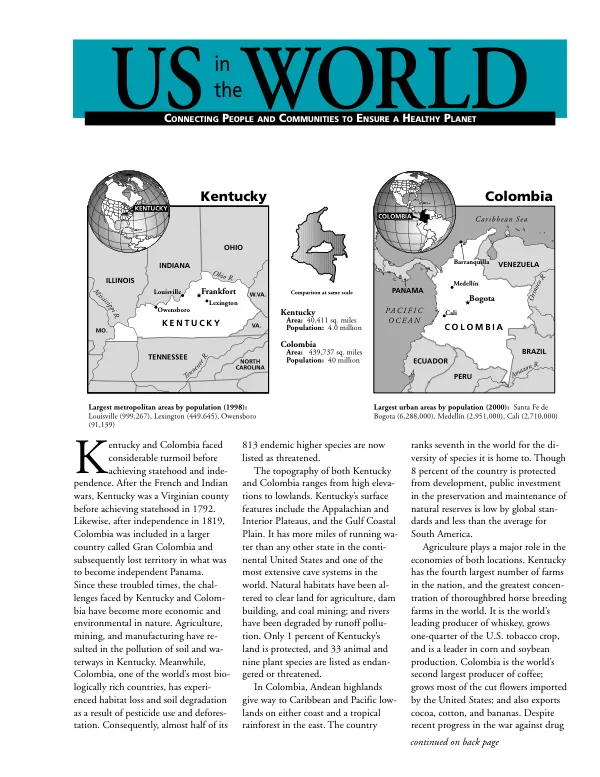
After the French and Indian wars, Kentucky was a Virginian county before achieving statehood in 1792. Similarly, after independence in 1819, Colombia was included in a larger country called Gran Colombia and subsequently lost territory in what was to become independent Panama. Since these troubled times, the challenges faced by Kentucky and Colombia have become more economic and environmental in nature. Agriculture, mining, and manufacturing have resulted in the pollution of soil and waterways in Kentucky. Meanwhile, Colombia, one of the world's most biologically rich countries, has experienced habitat loss and soil degradation as a result of pesticide use and deforestation. Consequently, almost half of its 813 endemic higher species are now listed as threatened. The topography of both Kentucky and Colombia ranges from high elevations to lowlands. Kentucky's surface features include the Appalachian and Interior Plateaus, and the Gulf Coastal Plain. It has more miles of running water than any other state in the continental United States and one of the most extensive cave systems in the world. Natural habitats have been altered to clear land for agriculture, dam building, and coal mining; and rivers have been degraded by runoff pollution. Only 1 percent of Kentucky's land is protected, and 33 animal and nine plant species are listed as endangered or threatened. In Colombia, Andean highlands give way to Caribbean and Pacific lowlands on either coast and a tropical rainforest in the east. The country ranks seventh in the world for the diversity of species it is home to. Though 8 percent of the country is protected from development, public investment in the preservation and maintenance of natural reserves is low by global standards and less than the average for South America. Agriculture plays a major role in the economies of both locations. Kentucky has the fourth largest number of farms in the nation, and the greatest concentration of thoroughbred horse breeding farms in the world. It is the world's leading producer of whiskey, grows one-quarter of the U.S. tobacco crop, and is a leader in corn and soybean production. Colombia is the world's second-largest producer of coffee; grows most of the cut flowers imported by the United States; and also exports cocoa, cotton, and bananas. Despite recent progress in the war against drug trafficking, these industries continue to pose environmental challenges. Kentucky has grown slightly more slowly than the nation as a whole during the last decade. Between 1990 and 1999, the "Bluegrass State" grew by 7 percent, from 3.7 million to 4.0 million. Like many other southern states, Kentucky grew during the 1990s because of net migration. An estimated 113,000 people, most of them arriving from other parts of the United States, relocated to Kentucky during the past decade. The percentage of total births to mothers who smoked while pregnant is high in Kentucky, almost 25 percent, compared with the national average of just over 13 percent. Smoking during pregnancy can lead to low birth weight and to infant mortality. Kentucky has 33 animals on the endangered and threatened list, including the Kentucky cave shrimp, the red-cockaded woodpecker, and three species of bats. Cumberland rosemary and Short's goldenrod are among the state's nine endangered or threatened plants. Despite efforts since the early 1970s to restore water, one-third of Kentucky's rivers and lakes still were found to have pollution problems in 1997. The north fork of the Kentucky River, the Upper Cumberland River, and the Licking River are three of the state's most polluted waterways. Since 1980, there have been major reductions in the level of exposure to ground-level ozone. However, studies show that 12 counties—primarily around Louisville, Lexington, and the suburbs near Cincinnati and Evansville—are apt to exceed new stricter standards for ground-level ozone. Colombia's population is projected to grow by 46 percent between 2000 and 2025, compared with 35 percent for South America overall. A large young population will lead to continued population growth as these youths become parents. One in every 36 Colombian children does not live to its first birthday. Immunization rates among infants for tuberculosis, polio, measles, diphtheria, pertussis, and tetanus are 10 to 15 percentage points lower than those for all of Latin America and the Caribbean. Colombia boasts the world's highest number of known breeding bird species—1,695. Twenty-nine of the country's 359 mammals are found nowhere else. Many of these species, however, such as the Amazonian manatee, plumbeous forest falcon, sapphire-bellied hummingbird, Santa-Marta parakeet, and indigo-winged parrot, are threatened by habitat loss. Colombia's annually renewable water per capita is over three times the U.S. level, but per capita water withdrawals in Colombia are just 11 percent of those in the United States