USAID DEC
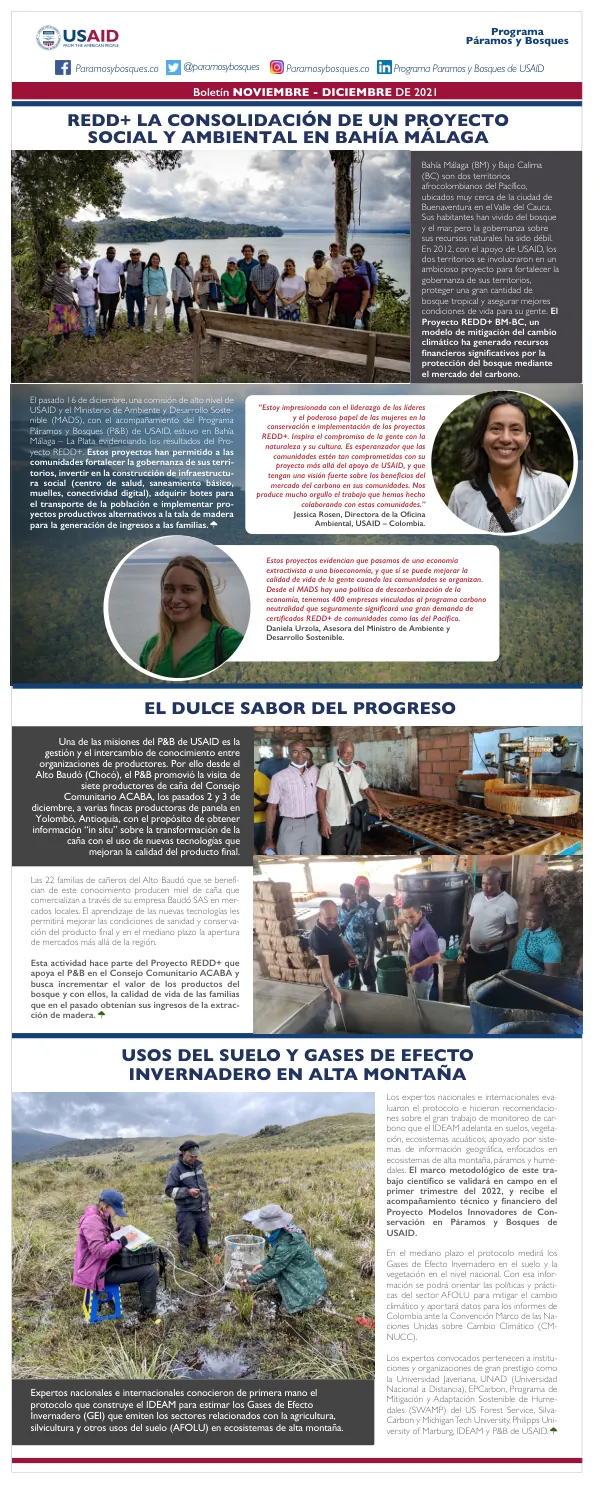
Boletín Noviembre - Diciembre 2019: REDD+, THE CONSOLIDATION OF A SOCIAL AND ENVIRONMENTAL PROJECT IN BAHÍA MÁLAGA
Sign inIDEAM
Boletín Noviembre - Diciembre 2019: REDD+, THE CONSOLIDATION OF A SOCIAL AND ENVIRONMENTAL PROJECT IN BAHÍA MÁLAGA
The REDD+ project in Bahía Málaga-La Plata has enabled communities to strengthen local governance, invest in social services infrastructure, and engage in economic activities that provide families with alternative income sources to logging.
2019 · 1 pages
Sign in to readA free account is required to download.
Abstract
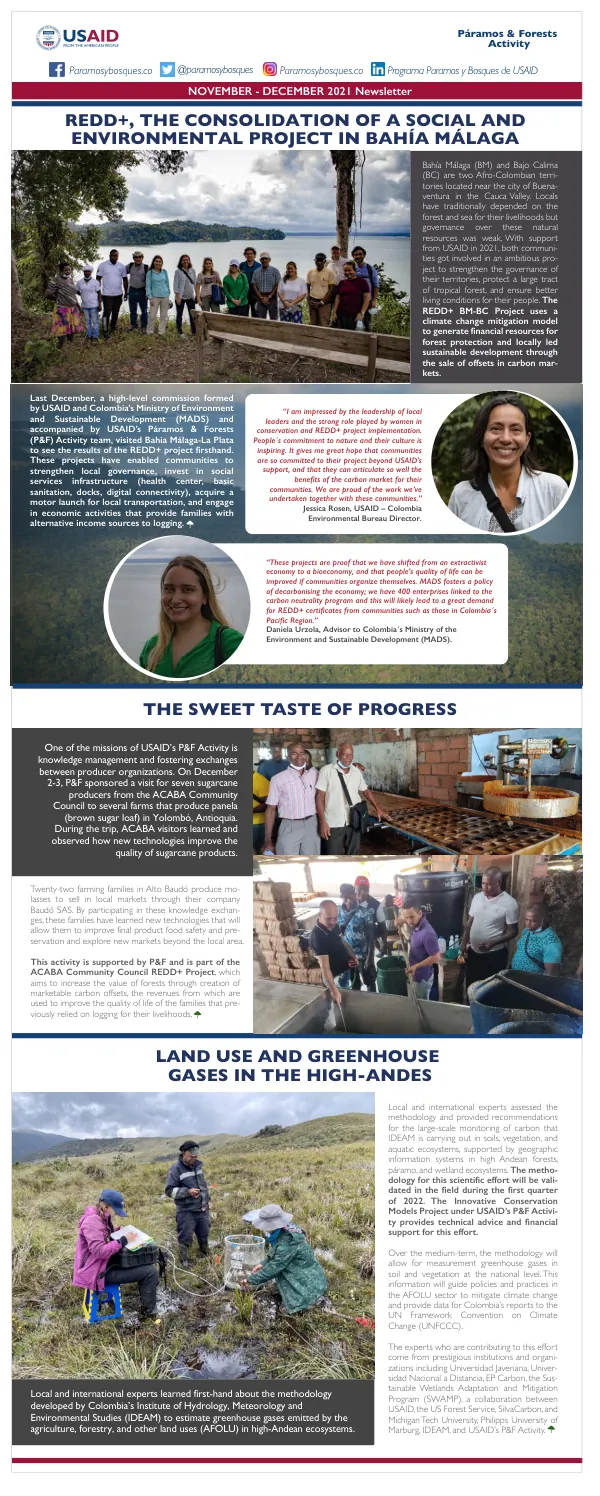
Twenty-two farming families in Alto Baudó produce molasses to sell in local markets through their company Baudó SAS. By participating in knowledge exchanges, these families have learned new technologies that will allow them to improve final product food safety and preservation and explore new markets beyond the local area. This activity is supported by the Páramos & Forests Activity and is part of the ACABA Community Council REDD+ Project, which aims to increase the value of forests through creation of marketable carbon offsets. The ACABA Community Council REDD+ Project uses a climate change mitigation model to generate financial resources for forest protection and locally led sustainable development through the sale of offsets in carbon markets. The project has enabled communities to acquire a motor launch for local transportation and engage in economic activities that provide families with alternative income sources to logging. Local and international experts have assessed the methodology developed by Colombia's Institute of Hydrology, Meteorology and Environmental Studies (IDEAM) to estimate greenhouse gases emitted by agriculture, forestry, and other land uses (AFOLU) in high-Andean ecosystems. The methodology for estimating greenhouse gases in high-Andean ecosystems will be validated in the field during the first quarter of 2022. The Innovative Conservation Models Project under USAID's Páramos & Forests Activity provides technical advice and financial support for this effort. Over the medium-term, the methodology will allow for measurement of greenhouse gases in soil and vegetation at the national level. This information will guide policies and practices in the AFOLU sector to mitigate climate change and provide data for Colombia's reports to the UN Framework Convention on Climate Change (UNFCCC). Bahía Málaga (BM) and Bajo Calima (BC) are two Afro-Colombian territories located near the city of Buenaventura in the Cauca Valley. Locals have traditionally depended on the forest and sea for their livelihoods but governance over these natural resources was weak. With support from USAID in 2021, both communities got involved in an ambitious project to strengthen the governance of their territories, protect a large tract of tropical forest, and ensure better living conditions for their people. The REDD+ BM-BC Project uses a climate change mitigation model to generate financial resources for forest protection and locally led sustainable development through the sale of offsets in carbon markets. The REDD+ BM-BC Project has enabled communities to strengthen the governance of their territories, protect a large tract of tropical forest, and ensure better living conditions for their people. Local leaders and women have played a strong role in conservation and project implementation. The project has also enabled communities to acquire a motor launch for local transportation and engage in economic activities that provide families with alternative income sources to logging. The project is a proof that communities can organize themselves and improve their quality of life through sustainable development.