ADVANCED ENGINEERING ASSOCIATES INTERNATIONAL, INC. /SGGA
Bosnia and Herzegovina (BiH) Regulatory and Energy Assistance Project (REAP)
The Bosnia and Herzegovina (BiH) Regulatory and Energy Assistance Project (REAP) is a project implemented by Advanced Engineering Associates International, Inc.
2014 · 8 pages
Sign in to readA free account is required to download.
Abstract
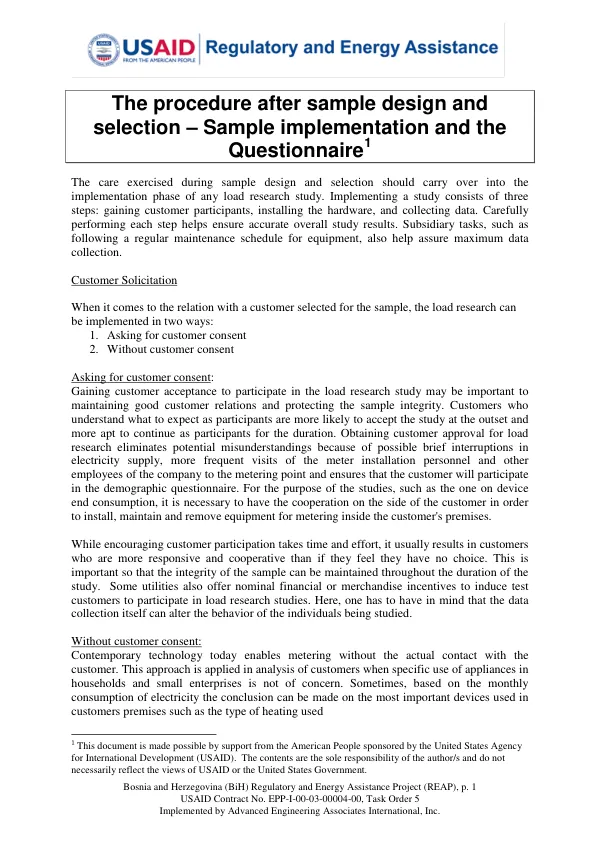
under USAID Contract No. EPP-I-00-03-00004-00, Task Order 5. The project involves load research studies to gather data on electricity consumption patterns in households and small enterprises. The implementation of a load research study consists of three steps: gaining customer participants, installing the hardware, and collecting data. Careful performance of each step is essential to ensure accurate overall study results. Subsidiary tasks, such as regular maintenance of equipment, also contribute to maximum data collection. Customer solicitation is a critical aspect of the load research study. Customers can be solicited in two ways: with or without their consent. Asking for customer consent is essential to maintaining good customer relations and protecting the sample integrity. Customers who understand what to expect as participants are more likely to accept the study and continue participating for the duration. When customer consent is obtained, the researcher can collect demographic and other relevant survey data from sample customers. This information includes family demographics, housing characteristics, and number of appliances in residential studies. In industrial and commercial studies, heating and cooling requirements, SIC codes, floor space, employment, and electric end-use loads may be collected. The survey can be conducted by mail, by phone, in person, or by any combination of the three. Mail surveys are the least expensive, but the response rate can be low and the accuracy of the responses can be suspect. Personal and phone interviews are more expensive, but they can produce more reliable and accurate information. In end-use studies, other considerations apply, such as non-random samples, demand-side management programs, and rate design experiments. Providing financial incentives becomes an important aspect of these kinds of studies. The customer's internal wiring may need to be changed to accommodate metering equipment, which adds to study costs and might make some customers reluctant to participate. To solicit customers for the end-use consumption study, the researcher needs to take into account the specific requirements of the study, such as the need for financial incentives and the potential for customer reluctance to participate due to changes in their internal wiring. The Bosnia and Herzegovina (BiH) Regulatory and Energy Assistance Project (REAP) has developed a sample customer participation letter and an example questionnaire for household participants in the load research program. The questionnaire collects information on the type of metering, facility location, approved capacity, and general household information, such as the number of household members and their employment status. The project's goal is to gather accurate and reliable data on electricity consumption patterns in households and small enterprises in Bosnia and Herzegovina. The data collected will be used to inform energy policy and regulatory decisions, ultimately contributing to the development of a more efficient and sustainable energy sector in the country.