DAI
Bridges to Employment Project
The Bridges to Employment Project in El Salvador aims to improve the enabling environment for workforce development and employment among vulnerable youth.
2018 · 13 pages
Sign in to readA free account is required to download.
Abstract
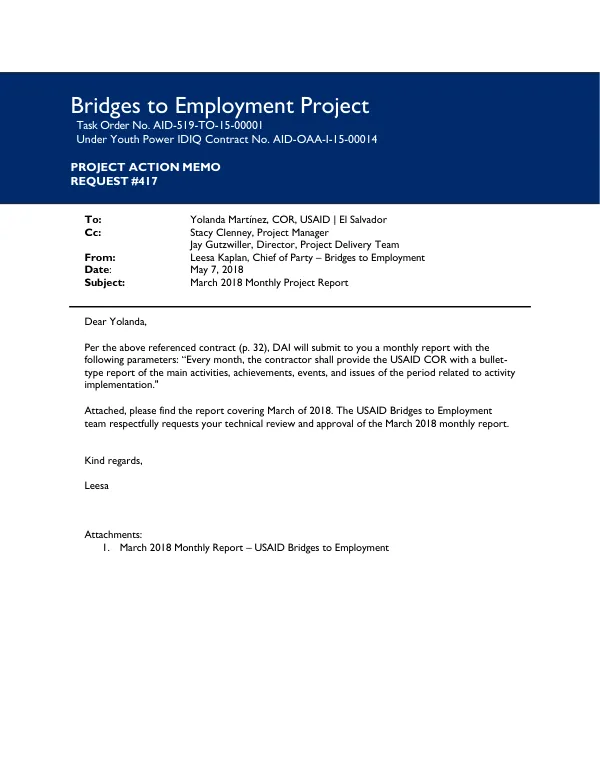
The project is implemented under the Youth Power IDIQ Contract No. AID-OAA-I-15-00014 and Task Order No. AID-519-TO-15-00001. In March 2018, the project team led by Leesa Kaplan, Chief of Party, attended the Comparative and International Education (CIES) Conference in Mexico. The team presented a new approach to improving life skills among vulnerable youth seeking employment opportunities. The presentation highlighted the work of the project in integrating life skills into technical training curricula for youth. The project is developing a toolkit for technical/vocational instructors to adapt their curricula and integrate life skills into their teaching approaches. The toolkit has generated interest among USAID/Washington, other YouthPower projects, and researchers, academics, and practitioners. The project is working to increase stakeholder engagement to improve the enabling environment for workforce development and employment. Key activities include policy reform, improving support to youth with disabilities, and improving private sector practices. The project is collaborating with the Instituto Nacional de la Juventud (INJUVE) to develop a new institutional policy to assist youth with disabilities and is working with Whitefox Consulting to assess corporate inclusion of vulnerable groups. The project is also strengthening alliances between training centers and companies to boost youth employment in El Salvador. Through partnerships with Distribuidora Salvadoreña, S.A de C.V (DISAL) and training centers, the project is providing training and employment opportunities in the tourism sector. The project aims to facilitate 150 jobs for vulnerable youth per year. The project's objective is to increase stakeholder engagement to improve the enabling environment for workforce development and employment. The project is working to address the needs of vulnerable youth, including those with disabilities, and is improving private sector practices to promote diversity, inclusion, and equality. The project's geographic focus is El Salvador, with a specific emphasis on the municipalities of San Salvador, Santa Tecla, Soyapango, San Miguel, Ahuachapán, and Zacamil. The project's timeframes are not explicitly stated, but the report covers the month of March 2018. The project's methodology involves collaborating with local stakeholders, including government agencies, training centers, and private sector companies. The project is using a toolkit to integrate life skills into technical training curricula and is assessing corporate inclusion of vulnerable groups. The project's key findings and conclusions include the importance of integrating life skills into technical training curricula and the need to improve private sector practices to promote diversity, inclusion, and equality. The project's implementation details include partnerships with training centers and companies to provide training and employment opportunities in the tourism sector. The project's recommendations include continuing to work with local stakeholders to improve the enabling environment for workforce development and employment and expanding the project's reach to include more vulnerable youth.
Related documents