USAID
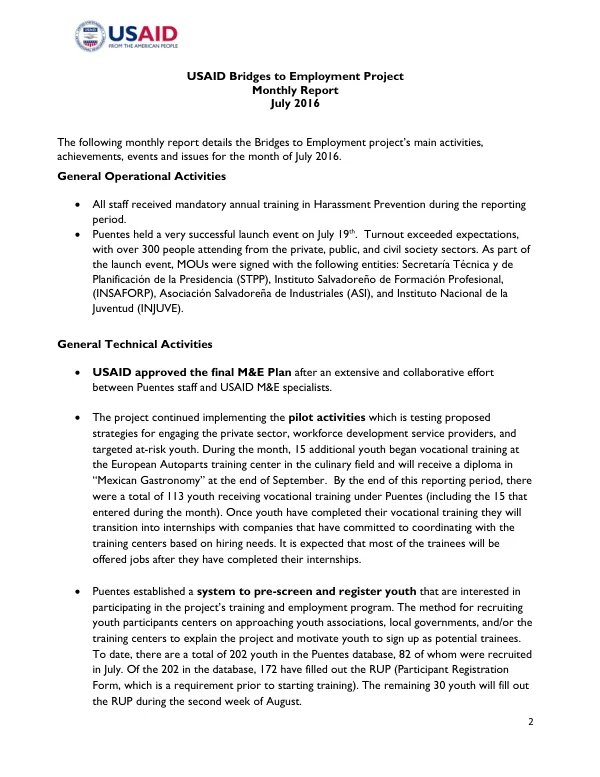
USAID Bridges to Employment Project Monthly Report July 2016
The Bridges to Employment project, a USAID initiative, aims to improve workforce development and employment opportunities for at-risk youth in El Salvador.
2016 · 6 pages
Sign in to readA free account is required to download.
Abstract
The project's main activities and achievements for July 2016 are detailed in this report. Puentes, the project's implementing partner, held a successful launch event on July 19th, attracting over 300 attendees from the private, public, and civil society sectors. The event marked the beginning of partnerships with key stakeholders, including the Secretaría Técnica y de Planificación de la Presidencia (STPP), Instituto Salvadoreño de Formación Profesional (INSAFORP), Asociación Salvadoreña de Industriales (ASI), and Instituto Nacional de la Juventud (INJUVE). The project continued to implement pilot activities, testing strategies for engaging the private sector, workforce development service providers, and targeted at-risk youth. During the month, 15 additional youth began vocational training at the European Autoparts training center in the culinary field, bringing the total number of youth receiving vocational training to 113. The project also established a system to pre-screen and register youth interested in participating in the training and employment program, with 202 youth in the database and 82 recruited in July. Meetings were held with municipal governments to introduce Puentes and determine coordination mechanisms. All four local governments expressed interest in partnering with Puentes and agreed to coordinate in areas such as carrying out focus groups, selecting and recruiting youth, and sharing municipal directories of private companies and registered youth. The project also continued to lead coordination meetings with other USG-funded projects working on improving opportunities in education and employment. The working group agreed to prioritize common topics, including curricular design, labor market studies, and teacher training. Puentes will focus on three of these topics: curricular design, training centers specialized in life and soft skills, and teacher training. Puentes participated in the CasaTIC Job Fair, which featured representatives from 15 private companies seeking young adult recruits with expertise in the IT field. The project set up an informational booth, visited by over 100 youth, and 51 signed up to participate in future training opportunities. The project also coordinated with other USG-funded projects to hold a joint presentation stand at the JuvenTOUR 2016 youth fair, hosted by INJUVE. Puentes secured the needed space and coordinated with the Ministry of Labor and CONAMYPE to promote youth employment opportunities and entrepreneurship. The Stakeholder Advisory Group was established, with consultation groups meeting to reach consensus on the group's structure and function. The group will serve as a sounding board and issue recommendations on Puentes' program implementation. A labor market assessment was conducted, with 141 interviews with private sector firms. Preliminary analyses show that the highest level of growth was reported in the pharmaceutical and plastic sectors. Respondents indicated that entry-level job applicants' deficiencies in basic skills and soft skills are major concerns, with many firms prioritizing an applicant's profile and behavioral characteristics over their expertise or professional background. The project conducted assessments of 10 workforce development service providers, with the remaining 10 assessments to be conducted in August. The results will inform decisions on which service providers will undergo institutional strengthening through an improvement plan during Year 2 of the project.
Related documents