DAI
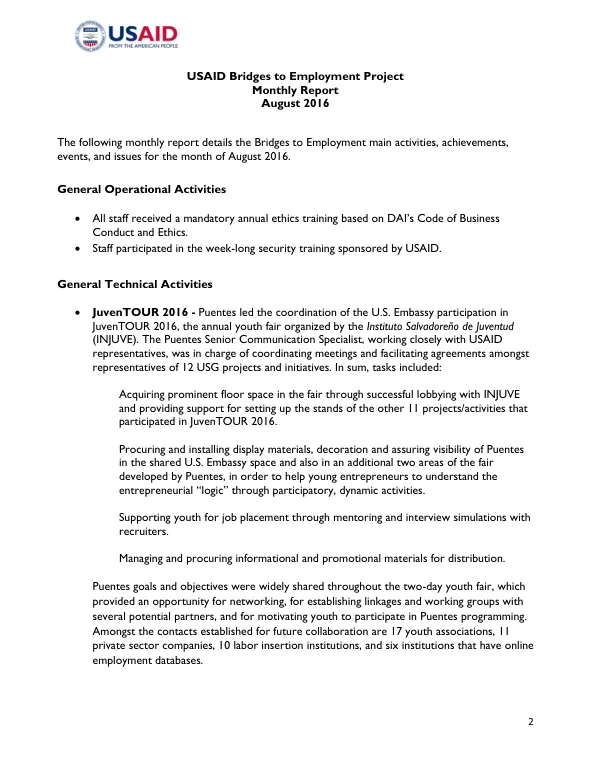
USAID Bridges to Employment Project Monthly Report August 2016
The Bridges to Employment Project, a USAID-funded initiative, aimed to improve workforce development and employment opportunities for at-risk youth in El Salvador.
2016 · 5 pages
Sign in to readA free account is required to download.
Abstract
The project focused on improving the enabling environment for workforce development, improving the quality of workforce development services, and improving workforce readiness. The project's enabling environment was strengthened through the formation of a Stakeholder Advisory Group, which brought together representatives from academia, civil society, public sector, private sector, and youth associations. The group aimed to provide input on the project's objectives and role. The Labor Market Observatory, a key initiative, was strengthened through a Memorandum of Understanding (MOU) with the Ministry of Labor. The project also conducted a labor market assessment, which involved data collection and analysis. The evaluation of the data was underway, and the final analysis was expected to guide the Work Plan for Year Two. A policy assessment was conducted through a focus group, which obtained the perception of multisector representatives on youth employment. Experts in the field of youth employment were also interviewed as part of the assessment. The project also conducted a private sector scan, which involved interviewing 40 private businesses from 16 sectors with high growth potential. The businesses showed significant interest in participating with the project, and data from the scan were being analyzed. The project's workforce development service providers were evaluated, with 17 service providers assessed and analysis of the data underway. Fifty youth started technical training in August, with 25 in a diploma course, 13 in an IT course, and 12 in a course on food and drink service. Recruitment started for 75 additional youth to begin a 13-month training course in the plastics sector. The project also collaborated with various partners, including the Ministry of Labor, the Ministry of Education, and the American Chamber of Commerce of El Salvador. The project also established partnerships with private sector companies, including CASATEX, CAMTEX, and CASS IT company. The project's objectives were to improve the enabling environment for workforce development, improve the quality of workforce development services, and improve workforce readiness. The project's activities were focused on achieving these objectives, and the results were expected to contribute to the development of a skilled workforce in El Salvador. The project's geographic focus was on El Salvador, with a focus on at-risk youth. The project's geographic focus was also on the target economy sectors, which included the plastics sector, the business development services sector, and the business development sector. The project's timeframes were not specified, but the report mentioned that the project was in its second year. The report also mentioned that the project was expected to continue for several years, with the goal of improving workforce development and employment opportunities for at-risk youth in El Salvador. The project's recommendations were not specified, but the report mentioned that the project's findings and recommendations would be presented in a report. The project's workforce readiness was demonstrated through the training of 50 youth in August, with 25 in a diploma course, 13 in an IT course, and 12 in a course on food and drink service. Recruitment started for 75 additional youth to begin a 13-month training course in the plastics sector. The project's collaborations with partners were ongoing, with the project working with the Ministry of Labor, the Ministry of Education, and the American Chamber of Salvador. The project also established partnerships with private sector companies, including CASATEX, CAMTEX, and CASS IT company.
Related documents