USAID DEC
Building a Supply Chain Approach for an Improved Laboratory Sample Referral Network in the Dominican Republic
Sign inMANAGEMENT SCIENCES FOR HEALTH
Building a Supply Chain Approach for an Improved Laboratory Sample Referral Network in the Dominican Republic
The Dominican Republic's disease control programs for HIV and TB reported difficulties with transporting laboratory samples and the turnaround of test results.
2014 · 1 pages
Sign in to readA free account is required to download.
Abstract
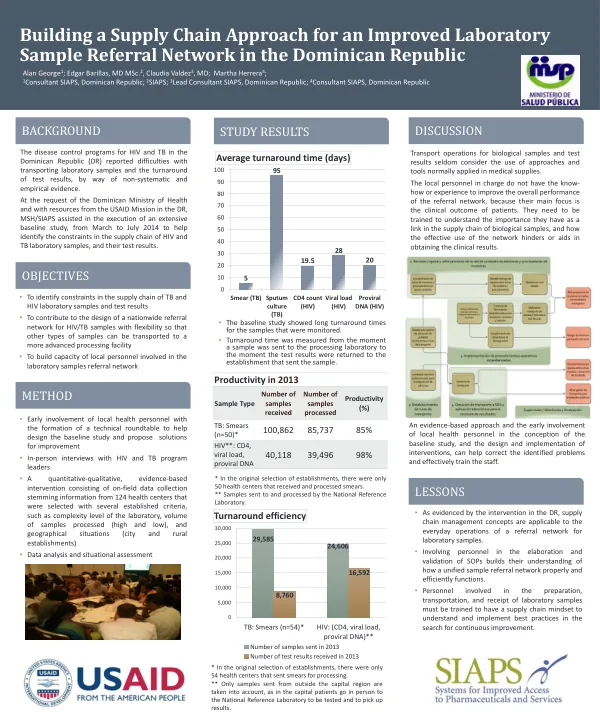
At the request of the Dominican Ministry of Health and with resources from the USAID Mission in the DR, MSH/SIAPS assisted in the execution of an extensive baseline study from March to July 2014 to identify the constraints in the supply chain of HIV and TB laboratory samples and their test results. The study aimed to identify constraints in the supply chain of TB and HIV laboratory samples and test results, contribute to the design of a nationwide referral network for HIV/TB samples, and build capacity of local personnel involved in the laboratory samples referral network. The study involved early involvement of local health personnel in the formation of a technical roundtable to help design the baseline study and propose solutions for improvement, in-person interviews with HIV and TB program leaders, and a quantitative-qualitative, evidence-based intervention consisting of on-field data collection from 124 health centers. The baseline study showed long turnaround times for the samples that were monitored, with an average turnaround time of 28 days for smear (TB) samples and 20 days for CD4 count (HIV) samples. The study also found that local personnel in charge of transporting laboratory samples and test results did not have the necessary knowledge or experience to improve the overall performance of the referral network. They needed to be trained to understand the importance they had as a link in the supply chain of biological samples and how the effective use of the network hindered or aided in obtaining clinical results. The study results showed that early involvement of local health personnel in the conception of the baseline study and the design and implementation of interventions can help correct the identified problems and effectively train the staff. The study also found that involving personnel in the elaboration and validation of standard operating procedures (SOPs) builds their understanding of how a unified sample referral network properly and efficiently functions. Productivity in 2013 was 85% for TB smear samples and 98% for HIV samples, with a total of 100,862 TB smear samples received and 39,496 HIV samples processed. The study recommended that local personnel involved in the preparation, transportation, and receipt of laboratory samples must be trained to have a supply chain mindset to understand and implement best practices in the search for continuous improvement. The study also suggested that the effective use of the referral network can hinder or aid in obtaining clinical results, and that the local personnel in charge of transporting laboratory samples and test results need to be trained to understand the importance they have as a link in the supply chain of biological samples.