AVENIR HEALTH
Financing Family Planning: Dominican Republic
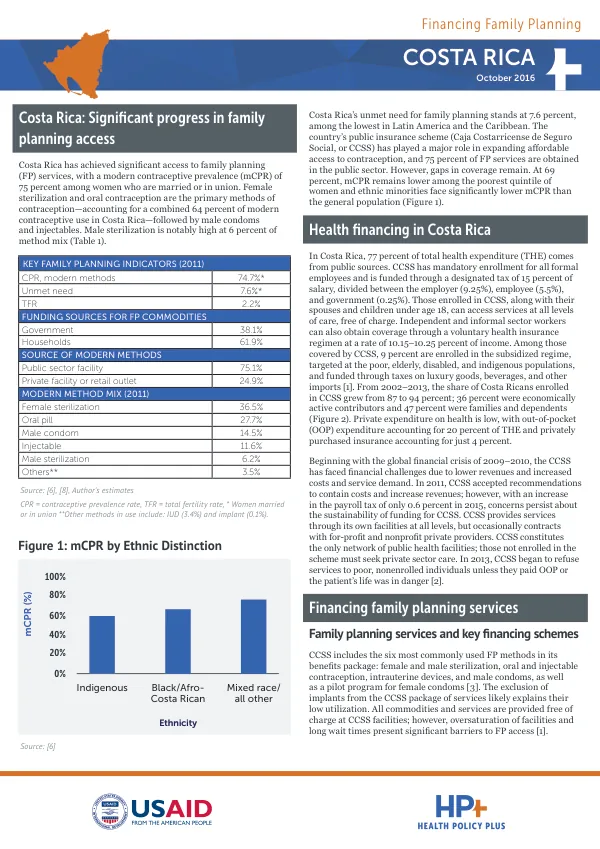
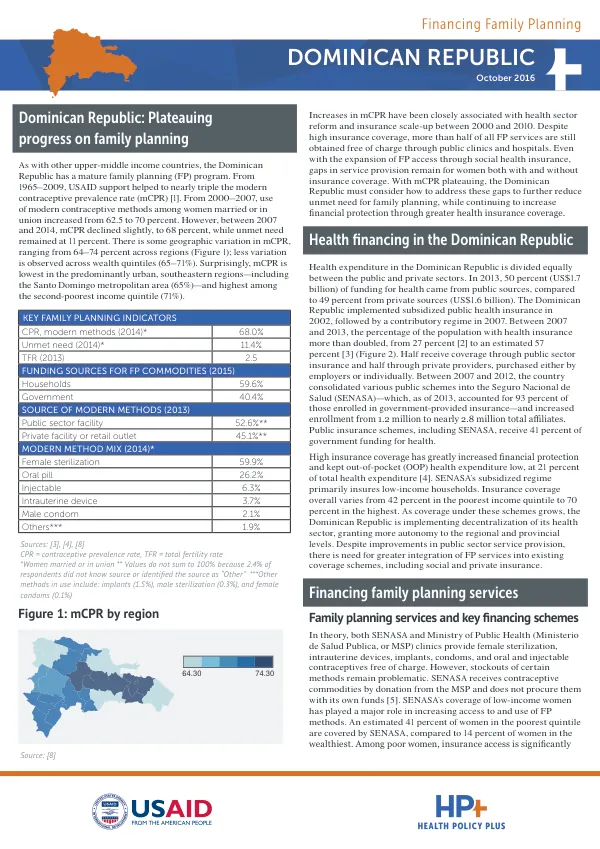
The Dominican Republic has a mature family planning program, with a modern contraceptive prevalence rate (mCPR) of 68 percent among women married or in union in 2014.
2016 · 2 pages
Sign in to readA free account is required to download.
Abstract
However, this rate has plateaued since 2007, and unmet need remains at 11 percent. The country has made significant progress in increasing health insurance coverage, with an estimated 57 percent of the population covered in 2013. Public insurance schemes, including the Seguro Nacional de Salud (SENASA), receive 41 percent of government funding for health and have greatly increased financial protection, keeping out-of-pocket (OOP) health expenditure low at 21 percent of total health expenditure. Despite high insurance coverage, gaps in service provision remain for women with and without insurance coverage. More than half of all family planning (FP) services are still obtained free of charge through public clinics and hospitals. However, stockouts of certain FP methods remain problematic, and SENASA receives contraceptive commodities by donation from the Ministry of Public Health (MSP) and does not procure them with its own funds. An estimated 41 percent of women in the poorest quintile are covered by SENASA, compared to 14 percent of women in the wealthiest quintile. The Dominican Republic has implemented subsidized public health insurance in 2002, followed by a contributory regime in 2007. Between 2007 and 2013, the percentage of the population with health insurance more than doubled, from 27 percent to an estimated 57 percent. Half of those enrolled in government-provided insurance receive coverage through public sector insurance, and half through private providers, purchased either by employers or individually. Public insurance schemes, including SENASA, receive 41 percent of government funding for health. Increasing insurance access has proved successful in increasing FP use, with mCPR highest among poor, insured women. However, gaps in benefits, specifically for private insurers, have left many women without access to FP services. Closing these gaps and continuing to expand access to public insurance schemes is necessary to reduce OOP payments that many women still face. The MSP has adopted a target to reduce unmet need for family planning to 5 percent by 2018, but experts consider the current budget of US$1.5 million for FP commodities insufficient to avoid stockouts at the national level.
Related documents