USAID DEC
Review of the List of High-Cost Medicines used by the Dominican Republic’s Protected Diseases Program and Planning of Purchases for 2015
Sign inMANAGEMENT SCIENCES FOR HEALTH
Review of the List of High-Cost Medicines used by the Dominican Republic’s Protected Diseases Program and Planning of Purchases for 2015
The Dominican Republic's Protected Diseases Program is responsible for providing high-cost clinical interventions, including treatment for hepatitis B and C, renal insufficiency, kidney transplants, leukemias, and certain low-incidence diseases.
2014 · 14 pages
Sign in to readA free account is required to download.
Abstract
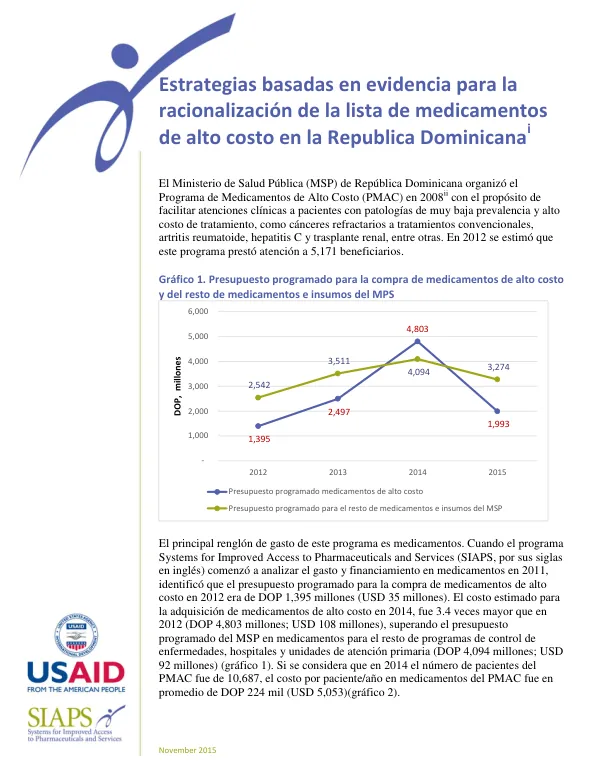
By 2013, the program had reached 11,868 patients. The program's budget for medicine procurement in 2014 was DOP 4.8 billion (USD 107 million), accounting for 51% of the Ministry of Public Health's budget for medicines that year. The program's resources for medicine procurement totaled DOP 2.116 billion (USD 49 million), leaving a shortfall of DOP 2.8 billion (USD 62 million). Due to the high cost of the medicines included in this group, the substantial percentage of the Ministry of Public Health's budget funds required for their purchase, and the limited amount of budget funds available, the program requested technical assistance from the Systems for Improved Access to Pharmaceuticals and Services (SIAPS) Program in conducting a review of the list of medicines to be made available and in subsequently planning medicine purchases for 2015. The objectives of the review were to facilitate the selection of medicines to be procured in 2015 using medical criteria based on evidence and cost-effectiveness, and to estimate and plan for purchases to be made for 2015 of medicines recommended for permanent inclusion on the program's list of medicines. A SIAPS consultant analyzed the therapeutic benefits and cost of the 95 medicines included on the program's list, using information sources such as the World Health Organization's Model List of Essential Medicines and the Pan American Health Organization's Strategic Fund. The report proposes four levels of prioritization for the 95 medicines analyzed: Priority 1, which includes medicines included on the World Health Organization's Model List of Essential Medicines and the Pan American Health Organization's Strategic Fund; Priority 2, which includes medicines included on the list for joint purchases to be made through the Council of Ministers of Health of Central America and the Dominican Republic; Priority 3, which includes medicines not included in the preceding groups but with scientific evidence supporting their use for specific health problems; and Priority 4, which includes medicines with limited or no scientific evidence supporting their use. The review also involved a preliminary analysis of the medicine list, which included an assessment of the therapeutic benefits and cost of each medicine. The report proposes a "Technical Report: Review of the List of Medicines used by the Dominican Republic's Protected Diseases Program," which could be used to support discussions with the various program scientific committees. The program's procurement planning for 2015 was carried out by the Protected Diseases Program team, with support from SIAPS. The final review and validation of the information were conducted by SIAPS consultants Claudia Valdez and Edgar Barillas, who were also responsible for editing the report. The report was presented to the US Agency for International Development by the Systems for Improved Access to Pharmaceuticals and Services (SIAPS) Program. The Dominican Republic's Ministry of Public Health is currently implementing an Integrated System for Medicine and Supply Management (SUGEMI), which aims to improve public access to essential medicines and quality health supplies while promoting the decentralized management and optimum use of available resources. SUGEMI is designed to bring about the gradual integration of all Ministry of Public Health programs, including the Protected Diseases Program, into a single supply management system. The Ministry of Public Health's budget for medicines in 2014 was DOP 9.6 billion (USD 217 million), accounting for 51% of the Ministry's budget for medicines that year. The Ministry's resources for medicine procurement totaled DOP 4.8 billion (USD 107 million), leaving a shortfall of DOP 4.8 billion (USD 107 million). The Ministry's procurement planning for 2015 was carried out by the Ministry's team, with support from SIAPS.
Related documents