USAID
Building Climate Resilience for Water Security
Improving the water security of individuals and communities hinges on managing weather and climate risk effectively.
2019 · 5 pages
Sign in to readA free account is required to download.
Abstract
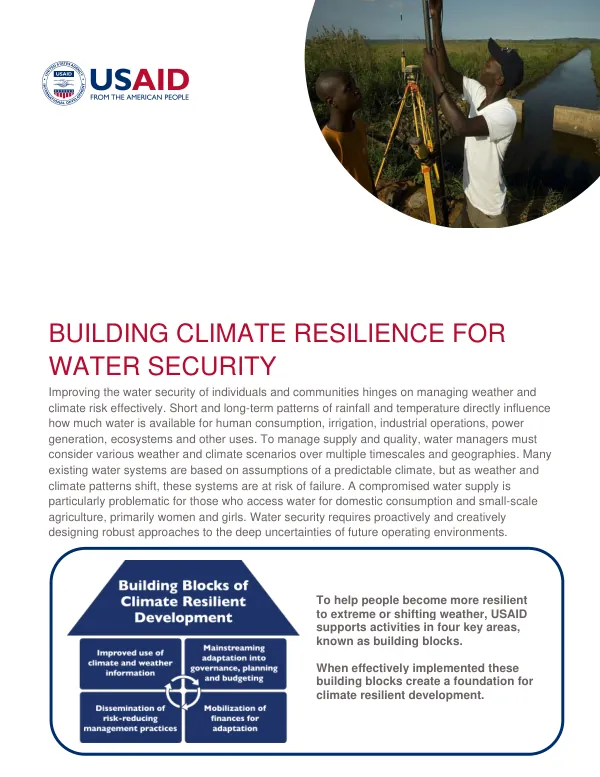
Short and long-term patterns of rainfall and temperature directly influence how much water is available for human consumption, irrigation, industrial operations, power generation, ecosystems, and other uses. To manage supply and quality, water managers must consider various weather and climate scenarios over multiple timescales and geographies. Many existing water systems are based on assumptions of a predictable climate, but as weather and climate patterns shift, these systems are at risk of failure. A compromised water supply is particularly problematic for those who access water for domestic consumption and small-scale agriculture, primarily women and girls. USAID supports activities in four key areas, known as building blocks, to help people become more resilient to extreme or shifting weather. These building blocks create a foundation for climate-resilient development when effectively implemented. The first building block focuses on improving the availability, quality, and use of weather and climate information. This involves providing technical assistance and capacity building to improve the supply of high-quality information through training, data provision, and network support for meteorology services and weather agencies. The second building block involves mainstreaming adaptation measures into governance, planning, and budgeting. USAID supports the improvement of policy frameworks and water-related planning and management processes to strengthen water governance, reduce existing inequalities in access, and achieve other development objectives such as economic growth and public health. This includes providing technical assistance and capacity building to help decision-makers integrate weather and climate information and supply and demand scenarios into basin management, land use, and disaster management. The third building block focuses on strengthening decision-making in water management. USAID supports communities in developing countries with training for community members and municipal officials to help establish water conservation areas and improve watershed management. This includes providing technical assistance to water management and water regulatory institutions to improve their effectiveness and supporting the integration of weather and climate information into water resource management, river basin management, and/or disaster risk management plans. The fourth building block involves facilitating water connections. USAID supports the development of model farms, training, and outreach to farming communities, and connecting farmers and households to financing. This includes reducing non-revenue water losses, restoring degraded upstream watersheds, and increasing water storage and water quality to meet downstream demand. By implementing these building blocks, countries can improve their water security and reduce the risks associated with weather and climate impacts on the water sector. In countries where accountability and enforcement are reasonably high, improved planning and water resource management can lead to reduced risk for people and assets, and thus increased water security. In countries that lack accountability and enforcement for planning and regulation, investments in better planning are less likely to succeed. High-quality, decision-relevant technical information and data are also important for informing and strengthening governance arrangements. A decision-support framework supported by good information helps guide interventions, while monitoring, evaluation, and learning can help determine which interventions to replicate. Engagement with all affected populations provides context and enables adaptive learning, and sharing results and providing training creates valuable feedback loops.