RTI INTERNATIONAL
Building Foundations for Local Governance in Iraq
The Local Governance Program in Iraq began in 2003 with the implementation of the first USAID contract by RTI International.
2009 · 2 pages
Sign in to readA free account is required to download.
Abstract
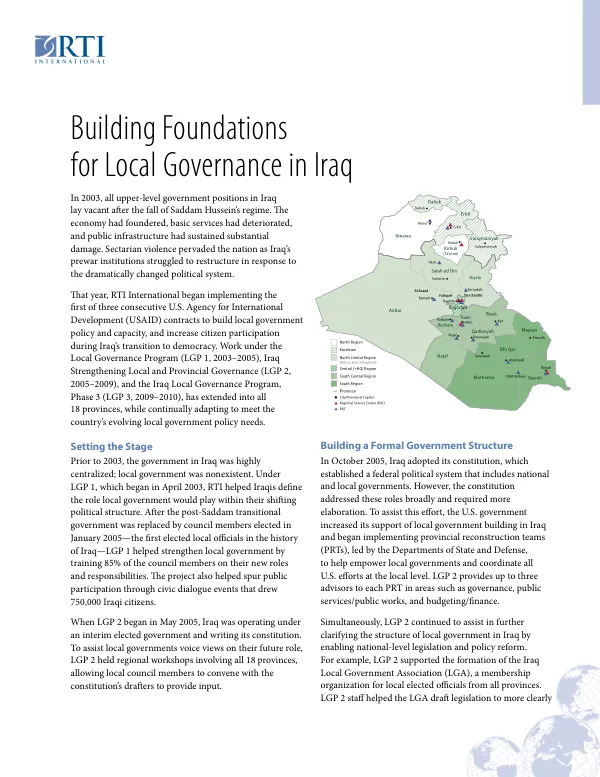
The program aimed to build local government policy and capacity, and increase citizen participation during Iraq's transition to democracy. Work under the Local Governance Program (LGP 1, 2003-2005), Iraq Strengthening Local and Provincial Governance (LGP 2, 2005-2009), and the Iraq Local Governance Program, Phase 3 (LGP 3, 2009-2010), extended into all 18 provinces, adapting to meet the country's evolving local government policy needs. Prior to 2003, the government in Iraq was highly centralized, with local government nonexistent. Under LGP 1, RTI helped Iraqis define the role local government would play within their shifting political structure. The project trained 85% of the council members on their new roles and responsibilities, and helped spur public participation through civic dialogue events that drew 750,000 Iraqi citizens. When LGP 2 began in May 2005, Iraq was operating under an interim elected government and writing its constitution. To assist local governments voice views on their future role, LGP 2 held regional workshops involving all 18 provinces, allowing local council members to convene with the constitution's drafters to provide input. The constitution, adopted in October 2005, established a federal political system that includes national and local governments. However, the constitution addressed these roles broadly and required more elaboration. To assist this effort, the U.S. government increased its support of local government building in Iraq and began implementing provincial reconstruction teams (PRTs) to help empower local governments and coordinate all U.S. efforts at the local level. LGP 2 provided up to three advisors to each PRT in areas such as governance, public services/public works, and budgeting/finance. LGP 2 also assisted in further clarifying the structure of local government in Iraq by enabling national-level legislation and policy reform. For example, LGP 2 supported the formation of the Iraq Local Government Association (LGA), a membership organization for local elected officials from all provinces. LGP 2 staff helped the LGA draft legislation to more clearly define local government powers and lobby for its passage. The legislation, the Law of Governorates Not Incorporated into a Region, was ratified in March 2008. Following ratification of the constitution, the national government began transferring a portion of its budget to provincial governments to finance capital investments in infrastructure and public works. Provincial governments had limited experience handling budgets and contracting for capital projects, so LGP 2 assisted them in developing a budget execution process and created a customized computer-based information system called GAPTIS, which automates financial accounting and project tracking while improving transparency. The system has been implemented in 11 provinces and is scheduled for implementation in three more in 2009. LGP 2 also worked with representatives from each province to help them create five-year Provincial Development Strategies (PDSs), or broad vision statements for development with capital investment strategies to reach those visions. All provinces presented their PDSs formally to the central government, including the prime minister, in March 2008. The central government agreed to incorporate these PDSs into the five-year National Development Plan. Subsequently, LGP 2 assisted provinces in transforming the PDSs into more detailed Provincial Development Plans (PDPs).
Related documents