AECOM INTERNATIONAL
Legislative Strengthening Program (LSP) Monthly Report
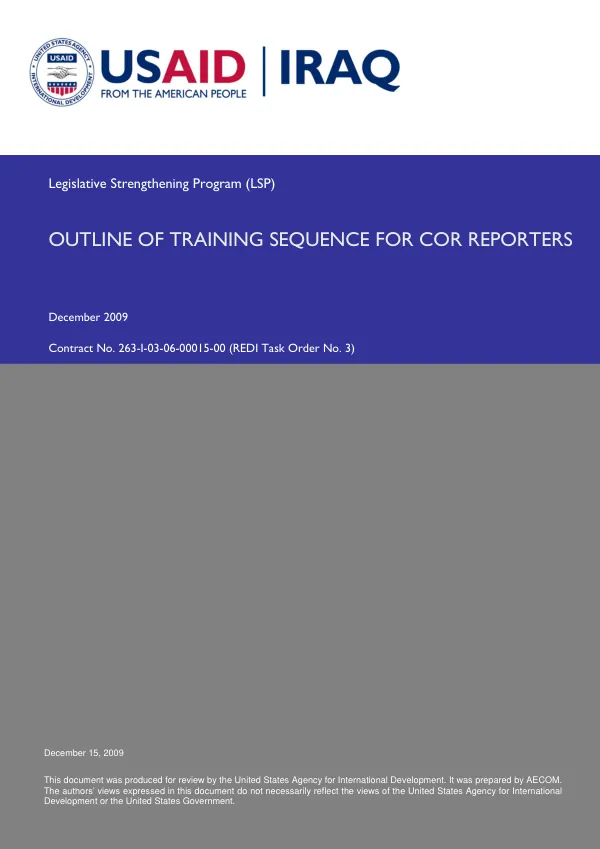
The Legislative Strengthening Program (LSP) in Iraq has developed a basic journalism training curriculum for journalists and media staff in the Council of Representatives (COR).
2009 · 4 pages
Sign in to readA free account is required to download.
Abstract
This effort is in direct response to LSP's Objective 5: Strengthened COR Outreach, specifically its Task 5.3.b. of its Year Two Annual Work Plan. The curriculum aims to improve the skills of journalists who cover the COR by combining topical study with practical work to carry out international standards of journalism in preparing reports on issues of importance to parliament. The curriculum would offer a number of separate workshops, related to topics of COR standing committees. These topics include complaints, parliamentary structure and mechanics, domestic security, defense, foreign affairs, legal, oil and gas, corruption, finance, economic development, education, health, environment, labor, regional and governorate structure, human rights, culture and anthropology, media, religious affairs, refugees, immigrants and IDPs, agriculture and water, government services, aviation, political prisoners, youth issues, women's issues, family and childhood, civil society, and tribal relations. The training activities will focus on the basic skills of journalism: reporting, interviewing, story development, etc. A part-time local co-trainer will work with an expatriate co-trainer on designing and sequencing the workshops. The expatriate trainer would work in-country initially, then remotely to design materials and plan other elements. Over the series of workshops, the local co-trainer(s) would gradually work more and more independently in preparing and conducting the workshops. LSP will maintain contact with the Media Directorate and the new association of parliamentary journalists. LSP's Communications & Outreach Specialist will oversee the process. Participants will be required to sign up well in advance, fill out an application form, sign a statement of understanding about the expectations for the course, submit a sample of their work, and choose the topics they prefer. To further obtain buy-in from the participants' media outlets, the application may include a space for signature/stamp indicating permission from their editors. A committee comprised of members from the Media Directorate, journalism association, and LSP will select and assign participants. A minimum of five participants, and an average of ten, will be selected. A typical workshop will last between 60 and 90 minutes per day for five days and be offered in the COR. The final product of each participant would be a story within the relevant topic which meets international standards. Participants could produce a news report or feature, including profile, documentary, explanatory, investigative, etc. Participants of each workshop would be required to pre-workshop, read the materials provided well in advance, generate and refine a report idea, develop questions and conduct interviews, outline the report, and write/produce the report. Each day would also include peer review and critique. Participants would receive a certificate upon completion of their reports. It would be expected that the reports would then be published in the participants' outlet of employment as a first option. If the employer declines to publish it, the participant may sell the story freelance. After local publication, the report could be published on a web site, maintained either by LSP staff or the co-trainer. In conjunction with the above training, an interviewing practicum should be conducted. This should commence after the new parliament is seated. The format would involve one-on-one interview between a journalist and a COR official, recorded on video, with a trainer observing, journalist and COR official complete self-critique form, trainer meets separately with journalist and COR official to provide feedback, and video used in future trainings.