USAID DEC
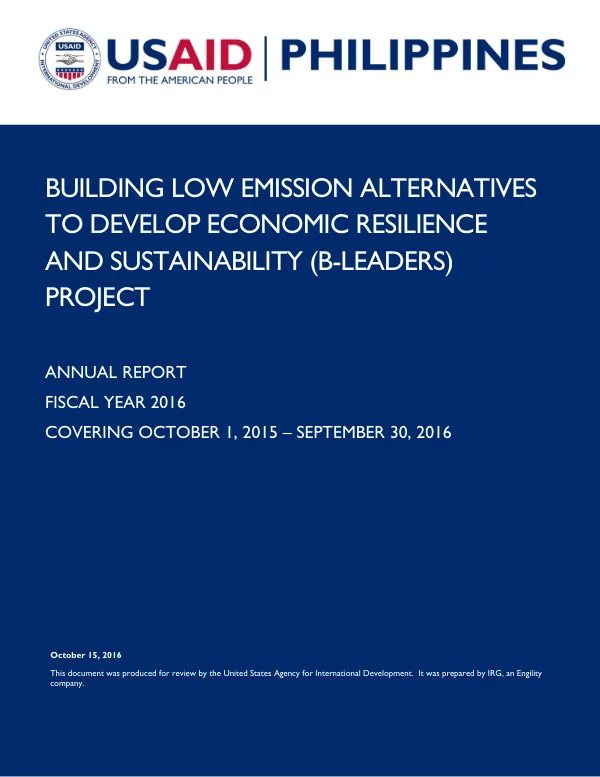
BUILDING LOW EMISSION ALTERNATIVES TO DEVELOP ECONOMIC RESILIENCE AND SUSTAINABILITY (B-LEADERS) PROJECT ANNUAL REPORT 2016
Sign inIRG
BUILDING LOW EMISSION ALTERNATIVES TO DEVELOP ECONOMIC RESILIENCE AND SUSTAINABILITY (B-LEADERS) PROJECT ANNUAL REPORT 2016
The Building Low Emission Alternatives to Develop Economic Resilience and Sustainability (B-LEADERS) project is a USAID-funded initiative aimed at promoting low-emission development strategies in the Philippines.
2016 · 58 pages
Sign in to readA free account is required to download.
Abstract
The project began in October 2015 and covered the period from October 1, 2015, to September 30, 2016. The project's primary objective is to strengthen in-country capacity on low-emission development, increase investments in clean energy projects, and enhance the resilience of cities to climate change. To achieve this, the project implemented various activities, including training programs for local government units, private sector companies, and civil society organizations. One of the key interventions was the establishment of the Cities Development Initiative (CDI), which aimed to enhance the resilience of cities to climate change. The CDI involved the development of a comprehensive climate change action plan for selected cities, which included strategies for reducing greenhouse gas emissions and improving disaster risk reduction and management. The project also focused on increasing investments in clean energy projects, particularly in the areas of renewable energy and energy efficiency. This was achieved through the development of a clean energy roadmap for the Philippines, which identified opportunities for clean energy development and provided a framework for policy and regulatory support. In addition, the project implemented various crosscutting activities, including gender equality and women empowerment, public-private partnerships, and production of communications and outreach materials. These activities aimed to promote the project's objectives and ensure that the benefits of low-emission development are shared equitably among all stakeholders. The project made significant progress in FY 2016, with notable achievements in the areas of clean energy development, climate change resilience, and gender equality. The project also leveraged significant funds from the private sector, with a total of $1.3 million in leveraged funds secured during the year. The project's success can be attributed to the strong partnerships established with local government units, private sector companies, and civil society organizations. The project's focus on low-emission development strategies and climate change resilience has also contributed to its success, as it has helped to promote a more sustainable and equitable development path for the Philippines. The project's achievements and lessons learned will be used to inform the development of the project's next phase, which will focus on scaling up the project's interventions and promoting low-emission development strategies at the national level. The project's success has also contributed to the Philippines' efforts to meet its commitments under the Paris Agreement, and has helped to promote a more sustainable and equitable development path for the country. The project's impact will be sustained through the establishment of a strong institutional framework, which will ensure the continued implementation of low-emission development strategies and climate change resilience initiatives. The project's success has also contributed to the development of a more sustainable and equitable development path for the Philippines, and has helped to promote a more resilient and climate-friendly economy.