ECO CONSULTING GROUP
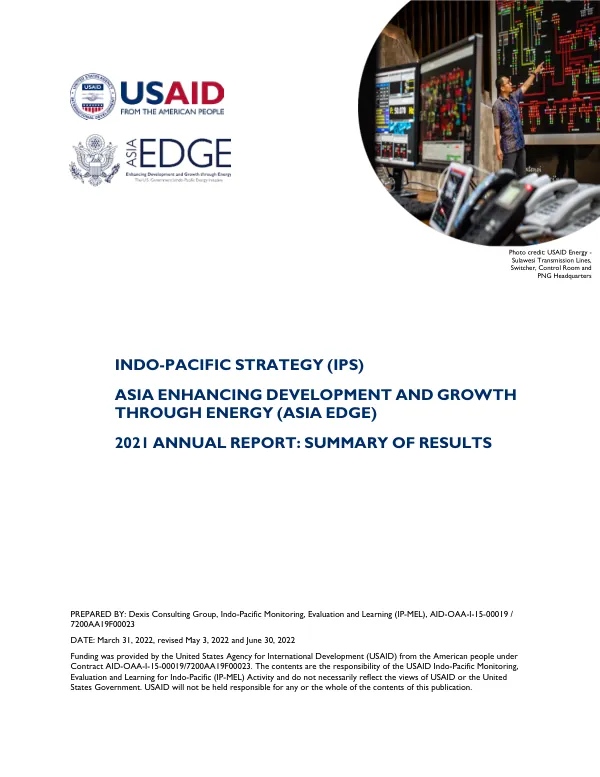
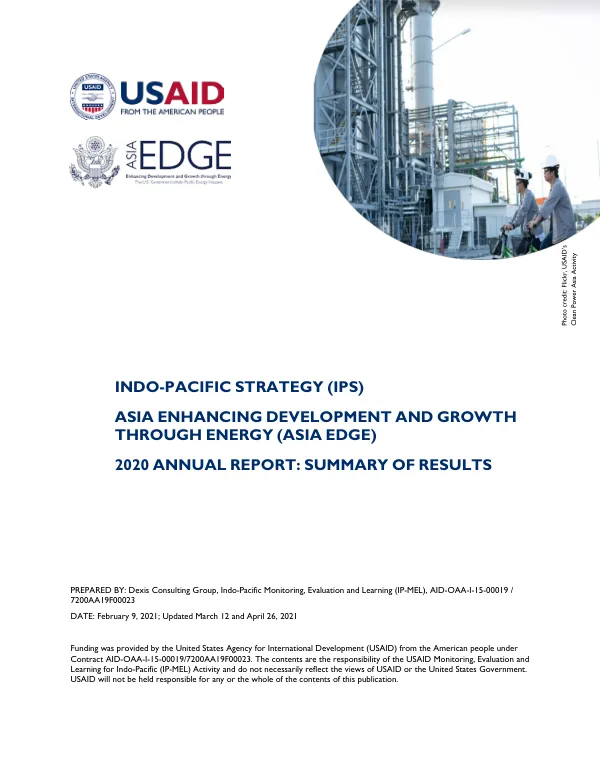
2020 Annual Report: Summary of Results for IPS ASIA EDGE
Asia EDGE is a whole-of-government initiative launched in July 2018 to grow sustainable and secure energy markets throughout the Indo-Pacific region, as part of the Indo-Pacific Strategy (IPS).
2021 · 49 pages
Sign in to readA free account is required to download.
Abstract
The initiative is designed to expand energy access, promote energy diversification and trade, and strengthen energy security across the region. USAID plays a leading role in helping its Indo-Pacific partners achieve these goals. The overall goal of Asia EDGE is to transform the energy sector to accelerate energy security and sustainability in the Indo-Pacific region. This goal is supported by four interconnecting Outcomes, related Intermediate Outcomes, and three Cross-cutting Outcomes. The Theory of Change (TOC) posits that if countries in the Indo-Pacific region pursue efforts to improve the performance of their energy utilities, increase the deployment of advanced energy systems, adopt transparent and best-value energy procurement practices, and enhance energy trade and regional integration, then the energy sector will be transformed, leading to energy security and sustainability in the Indo-Pacific region. The Asia EDGE TOC was developed with three important contextual assumptions: economic growth continues to grow globally and in the region without any major economic crises, the political environments in Indo-Pacific countries are stable, and foreign investment, especially from the U.S., continues flowing to the region. These assumptions are an important lens through which to view USAID results to date, given changing realities in terms of economic growth, political stability, and foreign investment in the Indo-Pacific region. In FY 2020, all reporting Asia EDGE countries made progress in improving the performance of their energy utilities. The average annual increase in the performance of energy utilities was 12%, with some countries achieving increases of up to 25%. This progress was driven by improvements in operational practices, such as the adoption of automated commercial environments and automatic dispatch systems. The deployment of advanced energy systems also increased in FY 2020, with a total of 1,500 megawatts of new capacity added to the grid. This represents a 20% increase over the previous year. The majority of this new capacity came from renewable energy sources, including solar and wind power. In addition to improving the performance of energy utilities and deploying advanced energy systems, Asia EDGE countries also made progress in adopting transparent and best-value energy procurement practices. The use of competitive procurement standards increased by 15% in FY 2020, with some countries achieving increases of up to 30%. Finally, Asia EDGE countries made progress in enhancing energy trade and regional integration. The total value of energy trade across the Indo-Pacific region increased by 10% in FY 2020, with some countries achieving increases of up to 20%. This progress was driven by improvements in regional energy connectivity, including the completion of several major energy infrastructure projects. Overall, the results of FY 2020 demonstrate that Asia EDGE is making progress in transforming the energy sector to accelerate energy security and sustainability in the Indo-Pacific region. The initiative's focus on improving the performance of energy utilities, deploying advanced energy systems, adopting transparent and best-value energy procurement practices, and enhancing energy trade and regional integration is paying off, and the region is becoming increasingly secure and sustainable.
Related documents