USAID
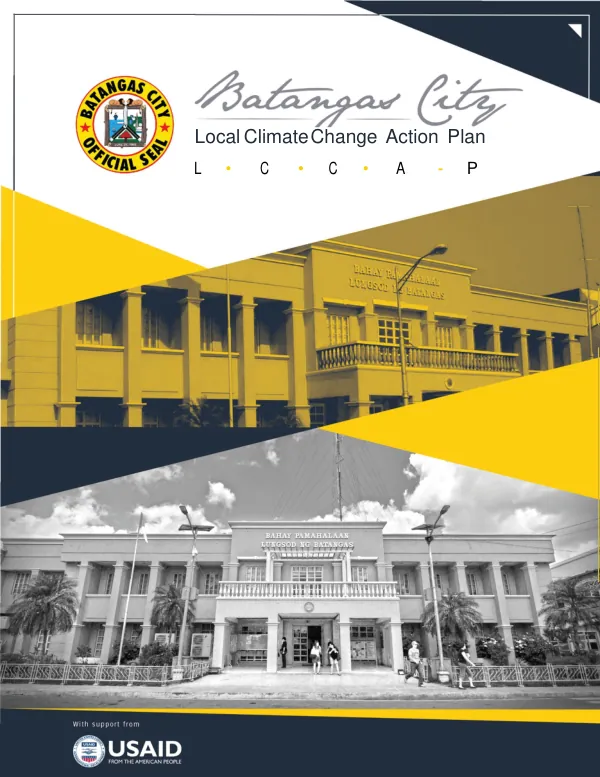
Local Climate Change Action Plan for Batangas City
Batangas City, located in the Philippines, is an industrialized coastal city that is not exempted from the adverse impacts of climate change.
2018 · 84 pages
Sign in to readA free account is required to download.
Abstract
The city's geographical orientation in the western side of the country generally spares it from the onslaught of most tropical cyclones, but it is listed as one of the cities to have threatened economies since its economic drivers can be paralyzed when stronger typhoons hit the country. The city's proximity to the sea and dependence on fishing make it vulnerable to impacts like rising sea levels, storm surges, warmer sea surface temperatures, and ocean acidification. Climate change is a multi-sectoral concern that requires the involvement of all levels of government in urban resilience and climate-smart planning processes. Upon the passage of Republic Act (RA) 9729 or the Climate Change Act of 2009, the National Climate Change Action Plan (NCCAP) was formulated through multi-sectoral consultations that considered the concerns of various sectors. The NCCAP outlines seven strategic priorities, including food security, environmental and ecological stability, water sufficiency, sustainable energy, knowledge and capacity development, human security, and climate-smart industries and services. The Batangas City Local Climate Change Action Plan (LCCAP) 2018-2028 is a ten-year plan that outlines specific programs and strategies for adaptation and mitigation. The plan is anchored on the local government's two major planning documents, namely the Comprehensive Land Use Plan (CLUP) and the Comprehensive Development Plan (CDP). The CLUP is an essential document and tool in determining the local government's land allocation and regulation, while the CDP provides strategic directions and guidance to the city's multi-sectoral programs, projects, and activities. The LCCAP builds on existing policies, programs, and good practices both national and local, including the CDP, CLUP, Environment Code, GHG Inventory Report, Local Shelter Plan, Transportation Management Plan, and Local Disaster Risk Reduction and Management Plan. The plan is expected to be updated every ten years coinciding with the updating of the CLUP and subjected for review every three years to ensure consistency with the local plans. Batangas City is a major industrial, commercial, educational, and recreational center, and it is the capital of Batangas Province and the largest of its three cities. The city has a population of over 300,000 people and is located in the southern part of the province. The city's economy is driven by industries such as manufacturing, tourism, and agriculture, and it is also a major hub for transportation and trade. The LCCAP aims to enhance the adaptive capacity and resilience of communities to climate change by implementing specific programs and strategies for adaptation and mitigation. The plan outlines how Batangas City can best manage its emissions given its resources and the policies that have been made available to address these. The plan also presents how Batangas City can best manage risks and protect vulnerable populations from the anticipated impacts of climate change. The implementation of the LCCAP will involve the participation of various stakeholders, including government agencies, civil society organizations, and the private sector. The plan will be implemented over a period of ten years, and it will be reviewed and updated every three years to ensure consistency with the local plans. The LCCAP is a critical component of the city's efforts to address climate change and to enhance the adaptive capacity and resilience of its communities.