MERCY CORPS INTERNATIONAL
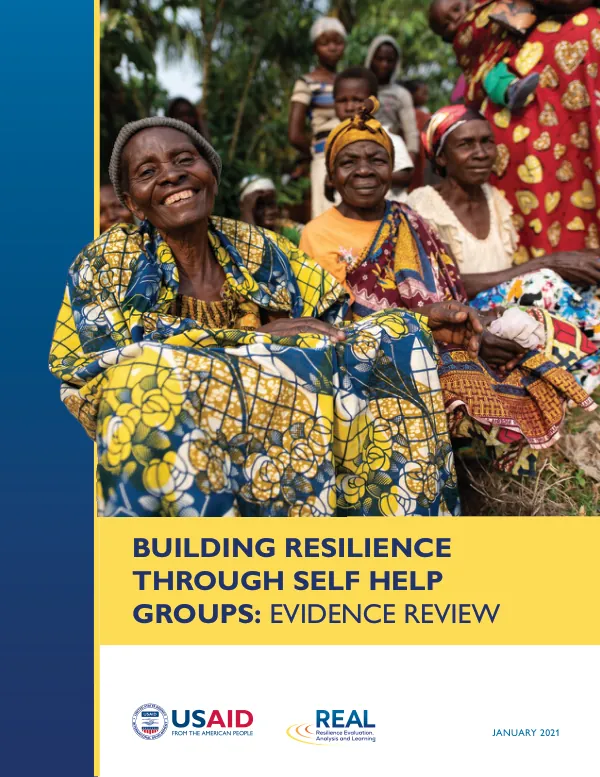
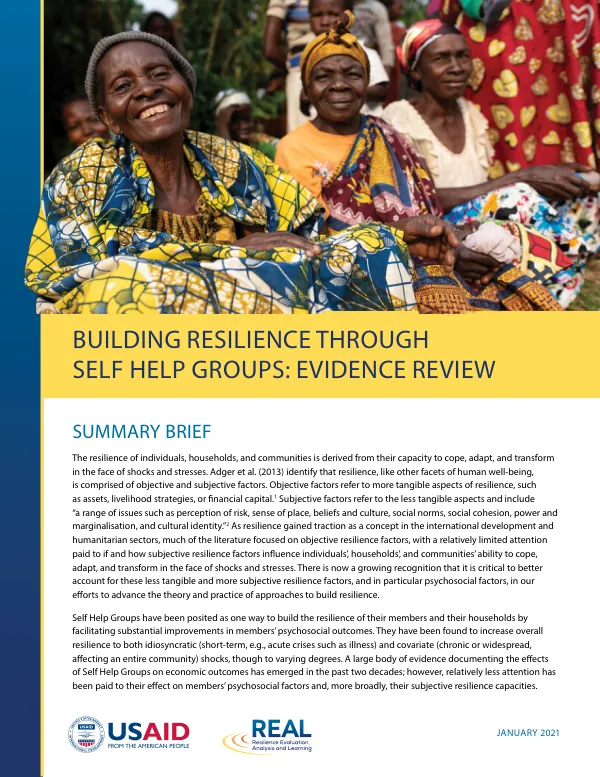
Building Resilience through Self Help Groups: Evidence Review_Summary Brief
The resilience of individuals, households, and communities is derived from their capacity to cope, adapt, and transform in the face of shocks and stresses.
2021 · 4 pages
Sign in to readA free account is required to download.
Abstract
Resilience is comprised of objective and subjective factors, with objective factors including assets, livelihood strategies, and financial capital, and subjective factors encompassing perception of risk, sense of place, beliefs and culture, social norms, social cohesion, power and marginalization, and cultural identity. Self Help Groups have been posited as one way to build the resilience of their members and their households by facilitating substantial improvements in members' psychosocial outcomes. Research indicates that Self Help Groups can increase overall resilience to both idiosyncratic and covariate shocks, though to varying degrees. A large body of evidence documenting the effects of Self Help Groups on economic outcomes has emerged in the past two decades, but relatively less attention has been paid to their effect on members' psychosocial factors and, more broadly, their subjective resilience capacities. The evidence reviewed for this report suggests that Self Help Groups, and women's groups more broadly, can have substantial consequences for a range of women's psychosocial factors. Women who are members of Self Help Groups, particularly those with access to savings, loans, and financial institutions, technical training and support, and group solidarity and networks, facilitate their members' greater psychosocial factors, which in combination with economic factors, strengthen members' and their households' abilities to be more resilient in the face of shocks and stresses. The review also identified a combination of factors central to Self Help Groups and the building of their members' psychosocial factors and resilience, including access to savings, loans, and financial institutions, technical support and advice, as well as group solidarity and networks. These psychosocial factors, such as social capital and women's empowerment, interact with economic factors facilitated through Self Help Group membership to strengthen members' and their households' abilities to be more resilient in the face of shocks and stresses. While the evidence base is limited and grounded largely in peer-reviewed studies from South Asia, the review indicates that Self Help Groups can have substantial consequences for a range of women's psychosocial factors. The evidence suggests that women who are members of Self Help Groups, particularly those with access to savings, loans, and financial institutions, technical training and support, and group solidarity and networks, facilitate their members' greater psychosocial factors, which in combination with economic factors, strengthen members' and their households' abilities to be more resilient in the face of shocks and stresses. The review highlights opportunities for future research, including understanding how psychosocial and economic factors intersect and either disrupt or complement each other within Self Help Groups. Additionally, research is needed to understand how Self Help Groups compare with Savings Groups in their facilitation of women's psychosocial factors, and how these groups can be layered with other types of activities, such as health or business skills training.